

Вітаємо на сайті Центру досліджень енергетики та чистого повітря (CREA).
Ми є незалежною дослідницькою організацією, що зосереджена на виявленні трендів, причин, наслідків для здоров’я, а також рішень щодо проблеми забруднення повітря.
Шкідливі для здоров’я забруднювачі, що утворюються внаслідок спалювання викопного палива, щорічно спричиняють щонайменше 3 млн смертей, пов’язаних із забрудненням повітря. Однак швидкий розвиток сучасних, чистих технологій у сфері енергетики надають суттєву можливість покращити якість повітря і захистити громадське здоров’я.
Ми використовуємо наукові дані, дослідження і докази, щоб підтримати зусилля урядів, компаній та агітаційних організацій щодо руху до чистішої енергії та чистішого повітря. Ми вважаємо, що ефективні дослідження та комунікація є визначальними для успішної політики, інвестиційних рішень і адвокаційних зусиль.
Контакт: getintouch@energyandcleanair.org



Останні новини
Червень 2026 року — Щомісячний аналіз російського експорту викопного палива та відповідних санкцій
Травень 2026 року — Щомісячний аналіз російського експорту викопного палива та відповідних санкцій
Квітень 2026 року — Щомісячний аналіз російського експорту викопного палива та відповідних санкцій
Останні публікації
З моменту вторгнення Росії в Україну кожен громадянин ЄС в середньому сплатив понад 400 євро за російське викопне паливо
Знімаємо завісу з «тіньових» танкерів
Від початку 2022 року відновлювані джерела енергії допомогли ЄС збільшити підземні сховища газу на 14%
CREA @Instagram
🇨🇳China Air Quality Trends | August 2026 | EN & CN
📈 After China tightened the annual PM2.5 standard from 35 to 30 µg/m³ in March, provincial capitals missing the standard jumped from 6 at the end of February to 18 by the end of March, and stayed high at 16 through May to August
📈💨 PM2.5 levels rose YoY in 18 provincial capitals in August, compared with only 2 in May when weather conditions were more favourable
📈💨Haikou saw notable YoY increases in ozone concentrations due to higher emissions and unfavourable weather
🌦️📉 Favourable weather conditions in the Yangtze River Delta helped drive down ozone concentration
☘️ Lower emissions clearly contributed to declining NO2 levels across most provincial capitals
Tap the link in bio to learn more about the snapshot.
#China #airquality #PM2.5 #airpollution #Beijing

⛳️ Indonesia’s dry season is worsening air pollution across the country.
On 8 September 2026, as the dry season intensified and pollution surged, nearly 57.8 million people were exposed. Forest and land fires added another layer of danger, particularly across Sumatra and Kalimantan. The impact is also felt disproportionately in regions outside Java.
This World Lung Day, the numbers remind us: clean air is a public health issue.
📍Track Indonesia’s air quality with CREA’s Indonesia Air Quality Tracker.
Tap on the link in bio to learn more
#WorldLungDay #Indonesia #AirPollution #PublicHealth #AirQuality
🇮🇩 How clean is the air in Indonesia?
Today, CREA is launching the Indonesia Air Quality Tracker, a new data tool that brings together air-quality information from across the country
CREA’s new Indonesia Air Quality Tracker lets you:
📍 Check real-time air quality and PM2.5 concentrations
📈 Explore air-quality trends over the past 30 days
👥 See which communities are impacted
The tracker draws on 181 official monitoring instruments across 155 monitoring sites in 119 cities.
Official sensors currently monitor air quality for 34% of Indonesians (97.7 million people within 20 km); nearly two-thirds of the population is still unmonitored.
To protect everyone’s right to clean air, monitoring needs to reach beyond major cities and into industrial hubs, mining areas and fire-prone regions.
To explore the Indonesia Air Quality Tracker, tap the link in bio
#Indonesia #AirPollution #AirQuality #CleanAir #PM2.5
⚕️🇿🇦 NEW | HEALTH IMPACT ASSESSMENT
On International Day of Clean Air for Blue Skies 2026, CREA published its health impact assessment (HIA) looking at the economic and health impacts of the world’s largest point-source emitter of greenhouse gases: Sasol Secunda coal-to-liquids facility, located in the Highveld Priority Area (HPA) of South Africa.
The report estimates that some 1,000 deaths are attributable to particulate matter (PM2.5) and nitrogen dioxide (NO2 ), specifically, from the facility’s operation.
In addition to deaths, the health impacts of air pollution cause long-term suffering and children are hit the hardest, with a knock-on effect on future generations.
CREA calls for strengthening South Africa’s air-quality regulations to better protect human health today and for future generations.
To read the full report, tap the link in bio
#CleanAirDay #Airpollution #SouthAfrica #healthawareness #children
CN H1 Coal Briefing: 🇨🇳 NEW | China – Coal power biannual review – H1 2026
Despite a shift to stricter policy on coal, China added 30 GW of new coal power plants in H1 2026.
Most of the coal plants entering operation today are the result of an approval boom in 2022-23.
Coal in China is thriving because of its policy design. Mechanisms like long-term contracts and capacity payments reward coal plants in spite of falling utility. In the coming years, if policies are not revised, more than 270 GW of coal would be added to China’s coal fleet, setting it back on its 15th Five-Year Plan goals.
Mandatory contracts and market design are curtailing cheap renewable energy. In H1 2026, China’s grid failed to absorb 360 TWh of wind and solar power, more than enough to cover energy demand growth in that period.
To learn more about China coal and how it affects the country’s energy systems, read our latest report, ‘Built for backup, contracted to run: China’s coal support system risks crowding out clean power’
w/ Global Energy Monitor
To learn more, tap on the link in bio
#China #Coal #CleanEnergy #CO2 #airpollution
🔋Why is Indonesia going big on producing nickel-based batteries when most Indonesians are buying electric vehicles (EVs) with nickel-free batteries?
🚙Indonesia’s battery ambitions are reaching a new milestone, but also revealing an interesting contradiction. While most EVs sold in Indonesia today use LFP (Lithium Iron Phosphate) batteries, the country continues to position nickel as the cornerstone of its long-term battery strategy.
🏭 Building a globally competitive nickel battery industry will take more than expanding production capacity. As demand evolves, success will increasingly depend on producing battery materials that meet the performance, quality, and increasingly stringent environmental standards of global markets.
🌱As nickel mining and processing continue to expand, reducing their environmental and climate impacts will be just as important as scaling production.
📊Our latest infographic takes another look at where battery demand is heading and what that means for Indonesia’s nickel strategy.
📖 For more on this topic, read our previous report: Indonesia’s nickel: Aimed at EVs, but still parked in stainless steel
Tap the link in bio
#EVs #nickel #batteries #Indonesia #coal
🇮🇩 NEW | REPORT – Mapping the invisible: A satellite reveal of Indonesia’s NOx hotspots
NOx is an invisible pollutant that is changing the trajectory of Indonesia’s air pollution problem. NOx, or nitrogen oxides, is a family of highly reactive gases produced mainly when fossil fuels are burned at high temperatures. NOx is an extremely harmful pollutant linked to adverse health impacts, including heart and lung diseases, and it creates other pollutants such as PM2.5, ground-level ozone, and acid rain. NOx emissions have been steadily rising in Indonesia and mainly come from three sectors: transport, power generation, and industry.
A new study by CREA has identified 29 NOx hotspots across Indonesia, compared with 9 point sources previously identified in the global catalogue. Satellite data now makes it possible to accurately identify the major sources of NOx pollution in Indonesia. The findings show that NOx pollution is not only an urban problem but also affects remote areas of Indonesia where carbon-intensive facilities don’t necessarily mean ‘away from dense populations’ but ‘limited air-quality monitoring’.
To learn more, tap the link in bio.
#Indonesia #Airpollution #NOx #Jakarta #Coal
📢 We are hiring!
👉️ Human Resources – Administrative Assistant
📍🇫🇮 Remote – Europe – Finland
🔎 CREA is looking for an energetic, proactive & detail-oriented candidate to join its team in a human resources, administration and finance role, working closely with internal teams & external partners worldwide
💡 🇫🇮 A high level of fluency in English & sufficient fluency in Finnish to handle practical administrative matters at CREA’s HQ in Finland are required for this role
Last date of application: 2nd September 2026
To learn more, tap on the link in bio
#Job #HRJob #ClimateJob #Hiring #RemoteWork
🇷🇺 Is Russian oil still entering the EU despite sanctions?
In our latest factsheet, we find that Georgia’s Black Sea ports of Kulevi and Batumi exported EUR 1.2 billion worth of fuel suspected of containing Russian oil to countries imposing sanctions.
A lack of enforcement of the EU’s ban on oil products made from Russian crude appears to be enabling Georgia to refine Russian crude and export the resulting products to sanctioning jurisdictions. Georgia’s Black Sea ports also appear to be blending, processing or re-exporting Russian refined products to the EU and other jurisdictions imposing sanctions.
These loopholes and enforcement gaps allow revenue from imports via Georgian ports to continue flowing into the Kremlin’s war chest.
Tap the link in our bio to read the full factsheet.
#Russia #Oil #Georgia #Ukraine #EU
🇨🇳 NEW | China Energy and Emissions Trends – June 2026 snapshot
In June 2026:
📉Coal output fell by almost 10% and imports increased by almost one third as a result of a coal mine explosion in Shanxi province in late May. In H1, coal output declined by 1.7%, matched by import growth of 1.7%
☀️🍃Solar and wind power capacity additions fell by 70% and 46% YoY, respectively, due to the high base in the same period last year ahead of a new pricing policy taking effect
🏗️📉 While steel output stabilised somewhat in June, as crude steel output grew by 0.4% YoY, it fell by 3% over H1. Cement output continued to fall by 5.6% YoY and 8% in H1
🚗📈NEVs accounted for over 50% of monthly vehicle exports for the first time in June, as NEV exports surged 160% YoY. In H1 2026, NEV exports grew 120% YoY
🪨📈 Fossil power generation rose 0.5% YoY in June and 2% in Q2, but remained below its 2023 peak.
Find the full snapshot in the link in bio.
#China #energy #fossilfuels #renewable #CREAsnapshots
🇮🇳 A Super El Niño is coming that will affect energy systems across the world, but India will be hit harder than anywhere else.
🌦️ Due to El Niño, wind and rain patterns will be affected, leading to a cut in India’s hydro and turbine power generation. Extreme high temperatures will drive up the demand for air conditioning. Within a year, India could be looking at a power gap of 18 TWh.
⚡️ This power demand gap could lead to a surge in coal-fired power that is estimated to release 17 million tonnes of CO2.
💨 Consequently, increased carbon dioxide emissions will cause more extreme temperatures and air pollution, leading to an estimated 2,700 deaths.
☀️ There is another way. Less affected by El Niño, solar power is playing an increasingly pivotal role in powering India’s grid, now meeting 24% of daytime power demand.
💡 Every additional solar panel and battery installed is a step towards future-proofing the grid against an extreme weather pattern like this one.
#India #ElNiño #heatwave #solarpower #fossilfuel
🇮🇩 Indonesia’s aluminium industry is expanding rapidly through downstream industrialisation, but a critical question remains: what will power this exponential industrial growth?
🚨 9.8 GW, or 78% of identified power capacity (operational and planned) for aluminium projects, comes from captive coal power plants. This figure risks locking the aluminium industry into carbon-emitting fossil fuels, similar to Indonesia’s nickel boom.
💡Indonesia’s aluminium industry has a geographical advantage over high-carbon emitter industries: Indonesia’s bauxite reserves are highly concentrated in West Kalimantan, the Riau Islands, and Central Kalimantan, with significant potential for regional grid integration and access to renewable energy resources. Note: North Kalimantan’s mega-hydropower projects and high-yield solar corridors.
🍃 The aluminium sector possesses both the utility and geographic positioning to increasingly decouple from fossil-fuel dependencies.
Read the full briefing, tap link in bio
#energytransition and #Indonesia #Aluminium #coal #crea
[CleanEnergy,Solar, Cleanair, Sustainable-development, Hilirisasi,Bauxite, Hydropower, Kalimantan]
CREA @X


🇷🇺 NEW | Monthly analysis of Russian fossil fuel exports & sanctions
📉 In September, Russia’s fossil fuel export revenues fell by 1% month-on-month (MoM) to EUR 625 mn per day; export volumes fell by 7%
🛢️ Russia’s crude oil export revenues fell 10% MoM to EUR 339 mn per day
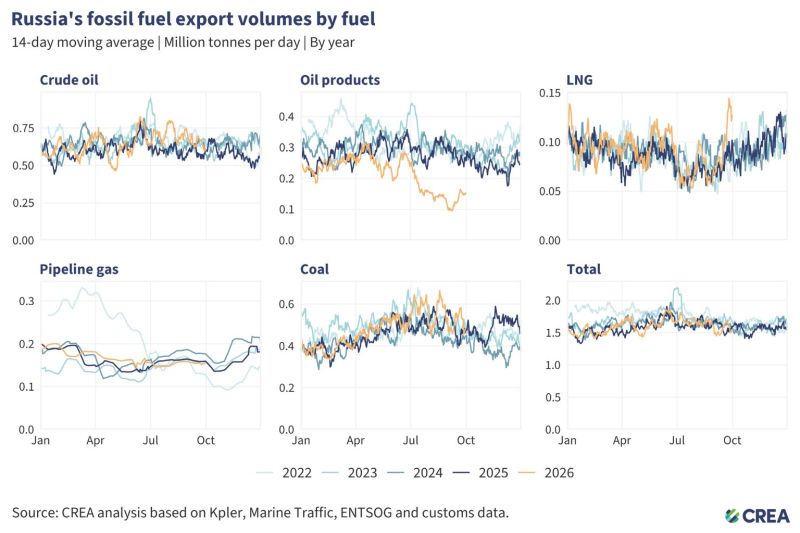
⚓Turkiye became Russia’s largest supplier, exporting 130 thousand tonnes in four shipments arriving from the Mersin port.
🇲🇦Morocco was the second largest supplier, with exports to Russia rising each of the last three months
🇷🇺 CREA’s monthly analysis on fossil fuel exports from Russia is now available here in EN & 🇺🇦 UA soon to follow:
Find all related CREA data here:
➡️ https://energyandcleanair.org/financing-putins-war/
September 2026 — Monthly analysis of Russian fossil fuel exports and sanctions – Centre for...
energyandcleanair.org
🇨🇳 NEW | #China #AirQuality Trends | September 2026 | EN & CN
⚠️📈Provincial capitals failing to meet China's new 30 µg/m³ standard jumped from 6 at the end of February to 18 by the end of March
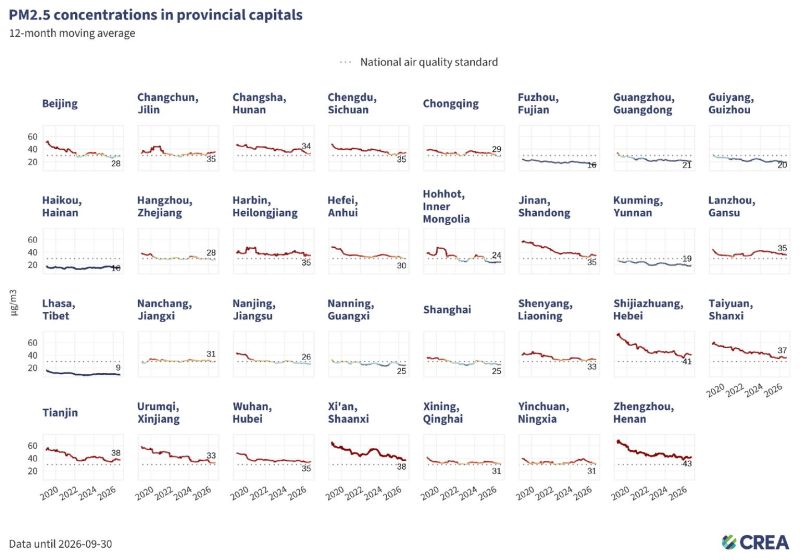
💨📉Lower emissions contributed clearly to declining NO2 levels across most provincial capitals

🇨🇳 CREA's September 2026 China Air Quality Trends is now available in EN & CN👇
▶️https://energyandcleanair.org/china-air-quality-trends-september-2026-snapshot/
*Image: Imaginechina/Sipa USA

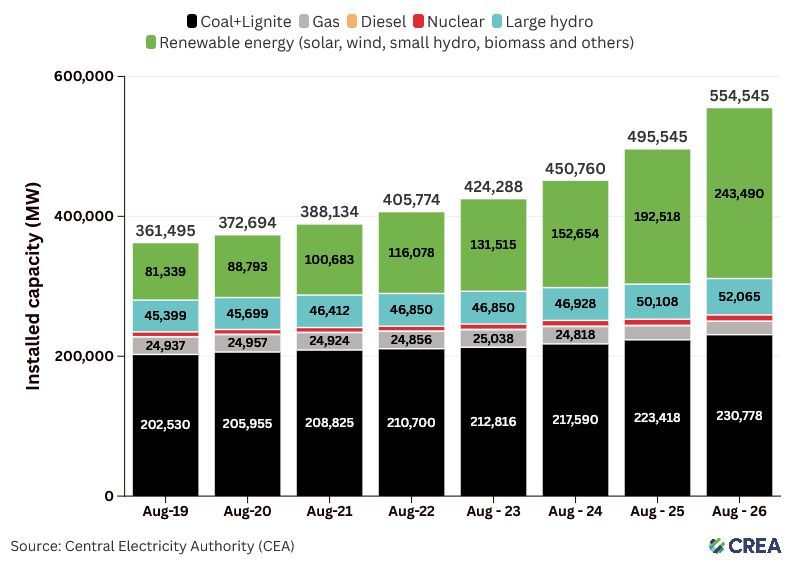
🇮🇳 NEW | #India Quarterly #Energy Snapshot is out now!
⚡📈 India’s electricity generation increased by 11% YoY during Q2 FY2026-27
☀️🏅 Renewable electricity generation (excluding large hydro) crossed 100 BU for the first time ⤵️
https://energyandcleanair.org/quarterly-energy-snapshot-for-india-q2-2026-27/
🇮🇳 NEW | #India September ambient #airquality snapshot out now
🥇💨 Panipat in Haryana ranked as the most polluted city in India in September 2026, recording a monthly average PM2.5 concentration of 78 µg/m³
⚠️❗️Haryana accounted for 5 of the 10 most polluted cities
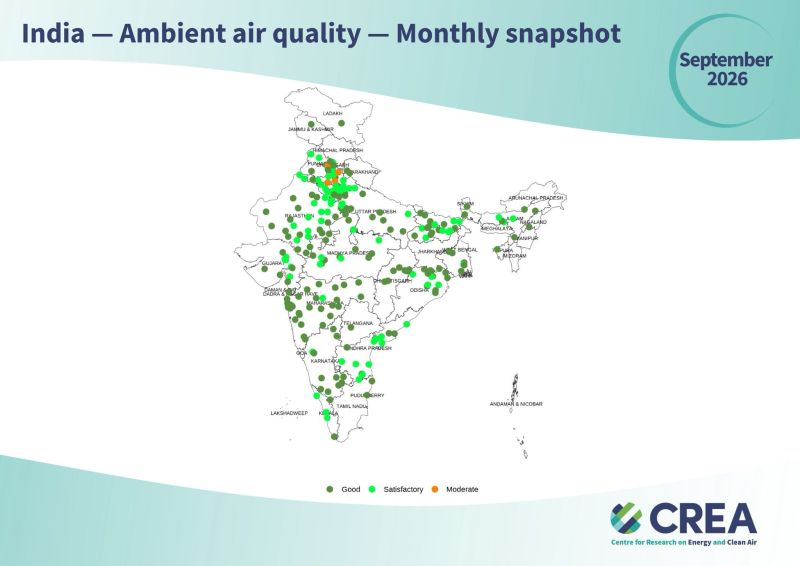
⚠️❗️A total of 62 cities were featured in the daily top 10 most polluted cities list in September 2026
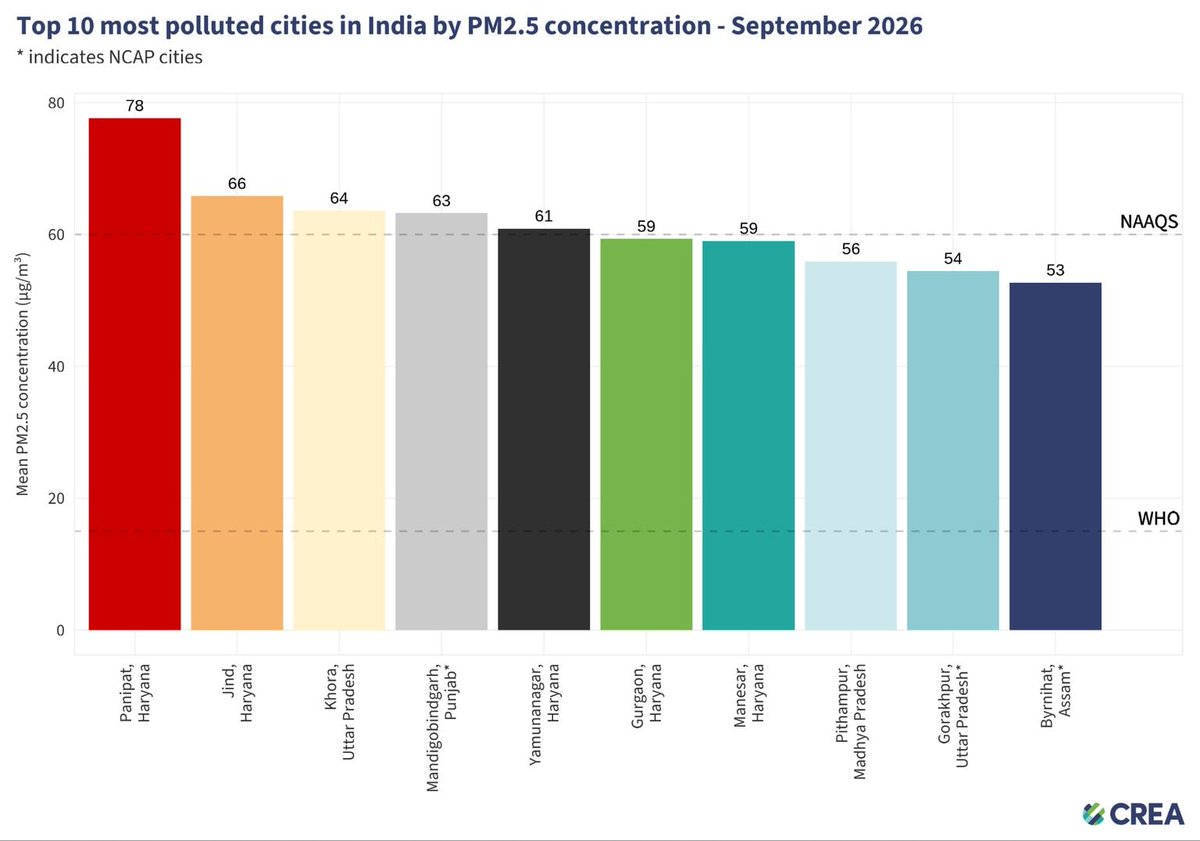
🇮🇳 CREA's ambient air quality monthly snapshot for India is now available here:
https://energyandcleanair.org/india-monthly-ambient-air-quality-snapshot-september-2026/
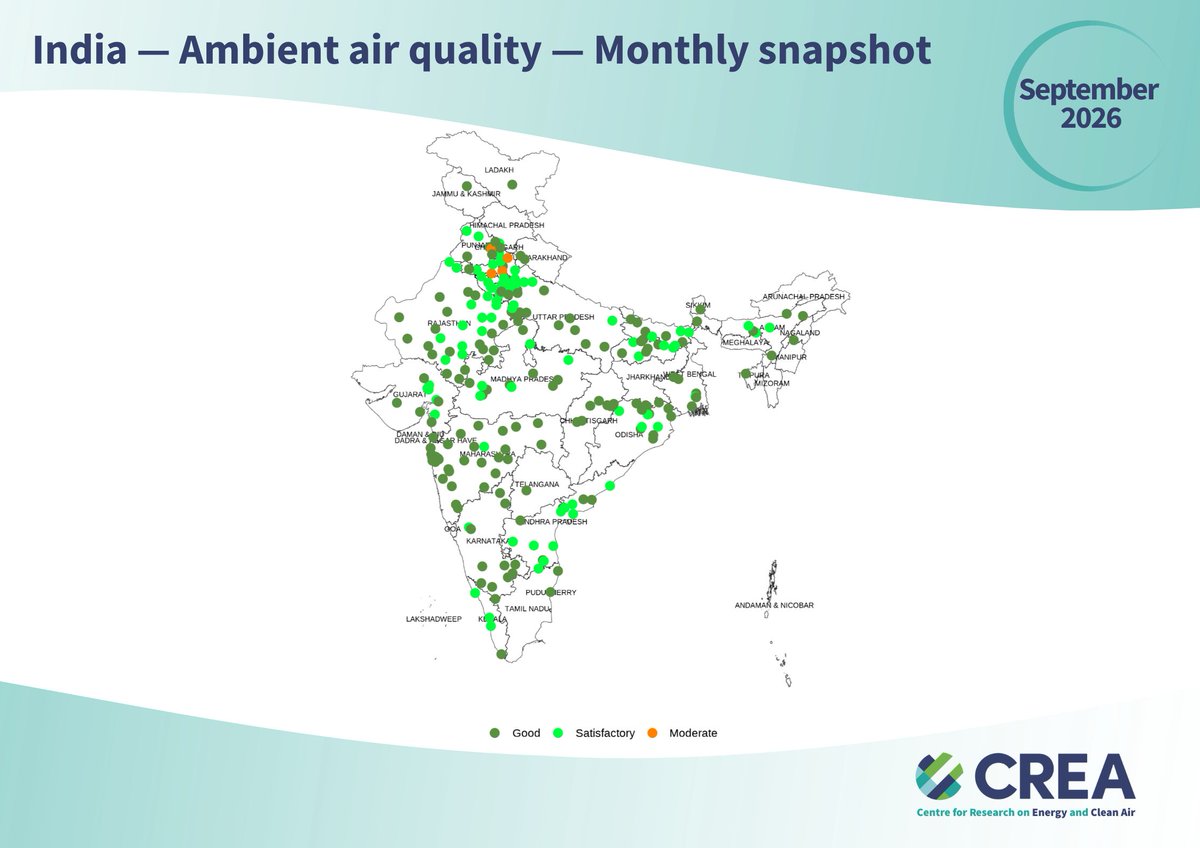
⚠️❗️A total of 62 cities were featured in the daily top 10 most polluted cities list in September 2026
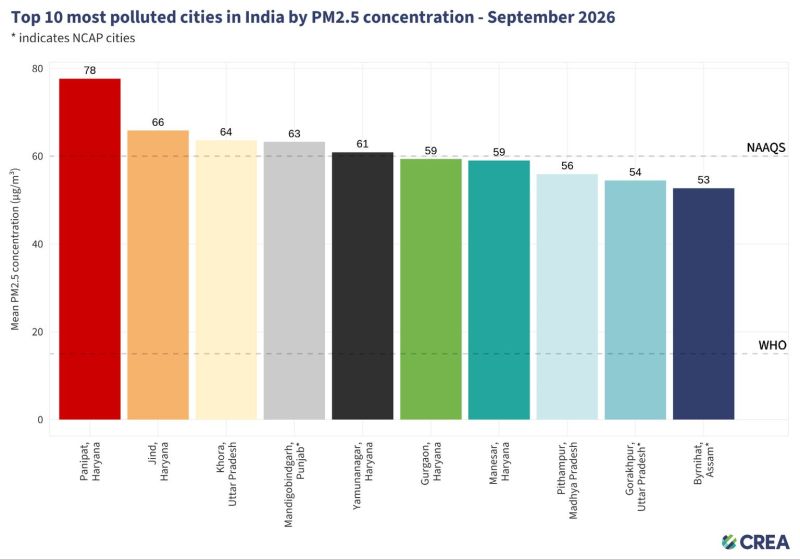
🇮🇳 CREA's ambient air quality monthly snapshot for India is now available here:
India monthly ambient air quality snapshot: September 2026 – Centre for Research on Energy and...
energyandcleanair.org
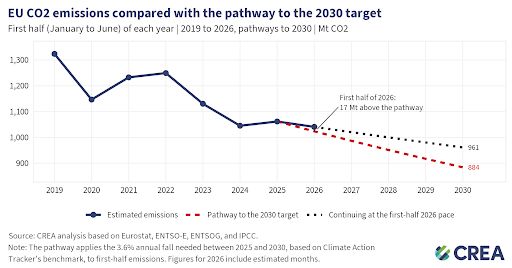
🇪🇺 NEW | Briefing: H1 2026 EU CO2 emissions from fossil fuels fell 2%
⚠️ But EU must reach 3.6% annual pace to meet 2030 climate target
💡 Industry & buildings oil emissions fell 10.8%, mostly March-June, after Hormuz crisis
🇵🇱🚨 Poland saw largest rise in H1 2026, from coal⤵️
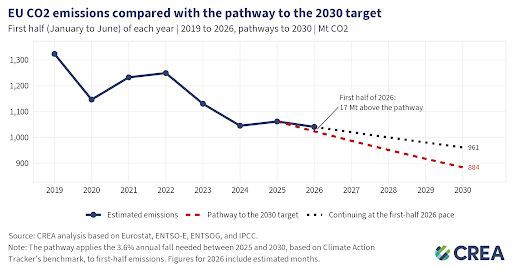
🇪🇺 CREA's H1 2026 EU CO2 emissions analysis is now available here:
https://energyandcleanair.org/publication/eu-co2-emissions-fell-2-percent-in-first-half-of-2026
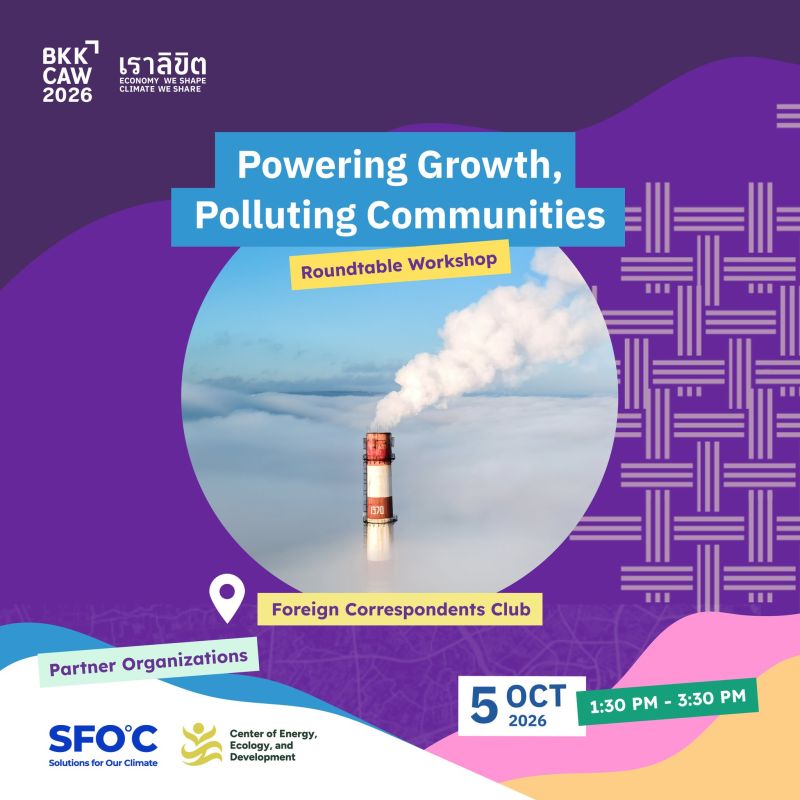
📢 What's On in Bangkok: Air Pollution, Public Health and the Hidden Costs of Gas Power
Join us during #BangkokClimateActionWeek 2026 for a discussion on how communities across Asia are responding to the air pollution and public health impacts associated with gas-fired power
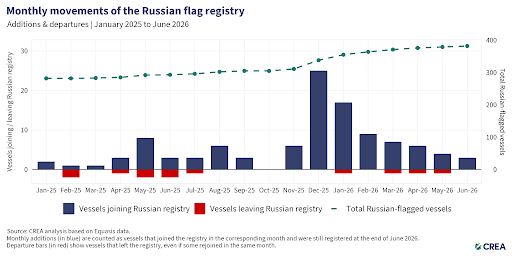
🇷🇺 NEW | Briefing: 107 vessels join Russian flag registry since Jan 2025
📈 From Jan 2025 to June 2026, registry grew 36%
⚠️ EUR 7.5bn of Russian fossil fuels delivered globally by end June 2026
🚨 Russian flagged Arctic-Metagaz suffered explosion & coastal states cleaned up⤵️
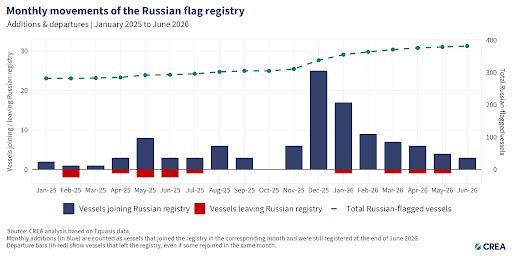
🇷🇺 CREA's briefing on the Russian flag registry is now available here:
https://energyandcleanair.org/publication/russian-flag-refuge-107-vessels-join-the-russian-flag-registry-since-january-2025
🇨🇳 🌍 NEW | Report: China-linked renewable generation in Brazil, Tanzania, UAE now tops potential generation of cancelled coal
⚠️ Private Chinese investment in Indonesian captive coal remains the biggest risk to undermining Beijing's 2021 overseas coal pledge 🧵⤵️
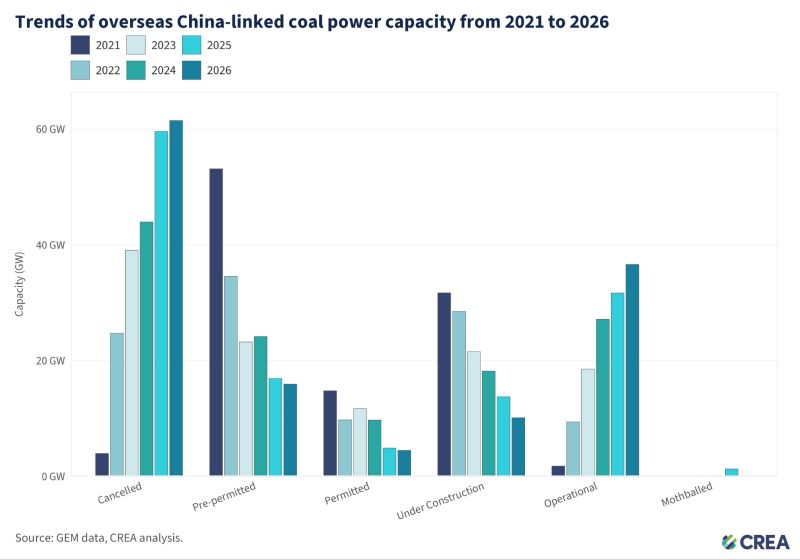
📄 Read CREA's fifth annual update on China's overseas coal ban here:
https://energyandcleanair.org/publication/five-years-on-china-seeds-overseas-renewables-growth-but-coal-ban-gaps-persist/
W/ People of Asia for Climate Solutions


