
Toxic fire smoke caused an estimated 3,560 deaths in September alone, while chronic urban pollution accounted for 1,750 deaths.
By Katherine Hasan, Analyst; Hubert Thieriot, Data Scientist; Candini Candanila, Analyst; and Lauri Myllyvirta, Lead Analyst and Co-Founder of CREA
🇮🇩 Versi Bahasa Indonesia tersedia di bawah
Key findings
- Air pollution-related deaths in Indonesia surged 42% from an estimated 3,740 in August to 5,310 (95% CI: 4,610-6,080) in September, driven primarily by forest and land fires (karhutla), which caused 3,560 deaths in September alone. Chronic, non-fire emissions from urban and industrial air pollution sources caused 1,750 deaths.
- Toxic fire smoke accounted for 94% to 99% of air pollution-related deaths in four provinces in Kalimantan and over 80% in multiple provinces in Sumatra, whereas Java’s deaths remained tied to urban and industrial sources, highlighting the disproportionate burden compared to urban centres in Java.
- The number of citizens exposed to “unhealthy” to “hazardous” air quality hit a monthly record peak of 58 million in September — a 40% jump from August’s peak. Citizens inhaling hazardous-level air in Kalimantan alone nearly tripled from 2.8 million to 6.4 million during the worst days of the month.
- In September, national population-weighted PM2.5 levels averaged 36 µg/m³, more than seven times the WHO annual guideline of 5 µg/m³, triggering an estimated 333,470 acute respiratory infection cases across seven karhutla-impacted provinces; children aged 0-5 accounted for nearly a quarter of cases.
- Fire activity in Kalimantan, Sulawesi, and Papua has surpassed 2015 records, yet the National Disaster Management Agency’s (Badan Nasional Penanggulangan Bencana, BNPB) ability to deliver emergency response is severely constrained, thanks to a 75% budget cut for 2026. As a result, the toxic smoke continues to choke citizens and spread beyond Indonesia’s borders.
- The government is facing heavy criticism for prioritising political and economic interests that benefit from a laissez-faire approach to land use, logging, and plantation expansion over public health and safety. On 20 October, the two-year mark of Prabowo-Gibran administration, student protestors took to the streets to demand that the government declare karhutla a national disaster and stop leaving underfunded provinces to handle the crisis alone.
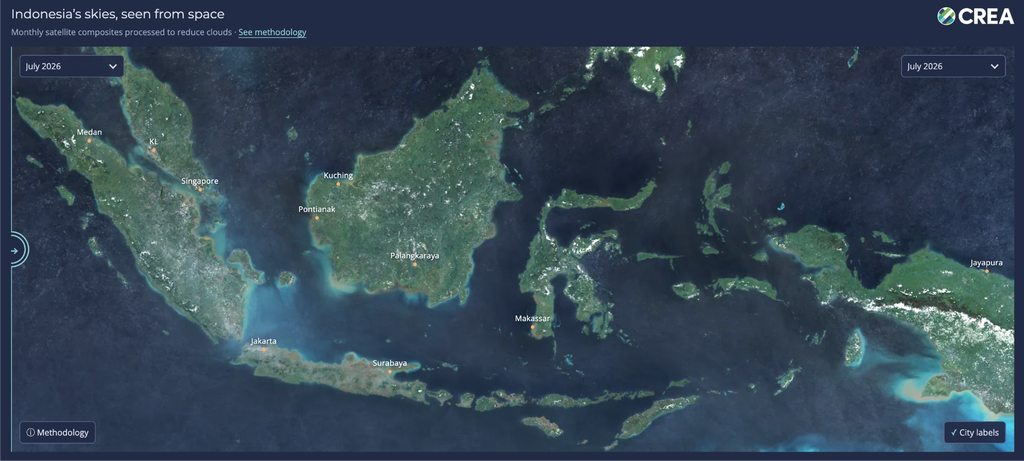
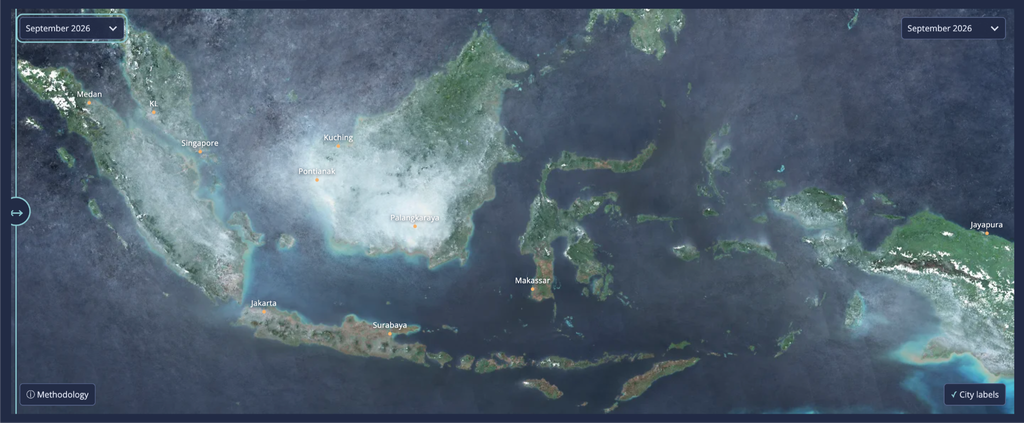
Image — Satellite image of haze coverage in Indonesia, July vs September 2026 (interactive version)
Introduction
The transition from August to September marked a drastic escalation in Indonesia’s air quality emergency, driving total monthly air pollution-attributable deaths up by 42%, from an estimated 3,740 to 5,310 nationwide.
While August marked the onset of Indonesia’s 2026 fire season with 1,700 fire-related deaths, September brought the anticipated peak of El Niño-driven dry conditions. The surge in forest and land fires (karhutla) pushed fine particulate matter (PM2.5) levels to unprecedented levels, resulting in an estimated 3,560 fire-related deaths nationwide — more than double August’s fire-related death estimates.
In contrast, chronic non-fire air pollution from power generation, industry, and transportation accounted for 1,750 deaths in September alone.
Non-fire pollution remains a persistent silent killer in Java, with a high concentration of urban and industrial sources; however, peaking fire events across Kalimantan, Sumatra, Sulawesi, and Papua have shifted the primary driver of air pollution-related deaths toward toxic fire smoke.
Figure 1 — Fire and non-fire PM2.5-attributable deaths across Indonesian island groups
Deaths in Kalimantan mainly driven by karhutla as extreme fires continue emitting toxic smoke through September
Figure 2 — Non-accidental deaths attributable to short-term exposure to ambient PM2.5 levels across the 15 most impacted Indonesian provinces (August–September 2026)
The fifteen provinces with the highest deaths related to PM2.5 exposure in August mostly remain unchanged compared to September, except for East Kalimantan, which took over South Sulawesi’s position as the 15th.
In August, West, South, Central, and East Kalimantan recorded an estimated total of 700 air pollution-related deaths. In just a month, this tally more than doubled to 1,470 deaths. It is important to note that the proportion of fire-related deaths reached 99% in West Kalimantan, South Kalimantan, and Central Kalimantan, and 94% in East Kalimantan.
In Sumatra, air pollution-related deaths across South Sumatra, Riau, Lampung, Jambi, and West Sumatra in August amounted to 760. Over the course of one month, the number increased by nearly two-fold, reaching 1,420 deaths throughout September. Fire-related deaths surpassed 90% in Riau, Jambi, and West Sumatra. South Sumatra, while having a slightly lower share for fire-related deaths (87%), had the highest absolute number of fire-related deaths (388) compared to other Sumatran provinces.
The data for Java, however, tells a different story. In September, in provinces across Java, such as West Java, Central Java, Jakarta, and Banten, 80% of deaths were attributed to non-fire air pollution sources, such as industry, vehicle emissions, and waste burning, while East Java had a slightly lower figure of 73%.
These figures underscore the stark reality that non-fire air pollution sources are as dangerous as smoke from burning forests and peatlands. The tally for deaths attributed to both fire and non-fire sources in these provinces in Java came to 1,570 in August and 1,530 in September — signalling stagnant, persistently high levels of air pollution across Indonesia’s most populated island.
September saw a new high, with nearly 58 million people in Indonesia breathing toxic air
At the peak in August, Indonesia saw 41.3 million people inhaling unhealthy to hazardous air; September brought a new record of 57.8 million people.
The percentage of exposed population surged by 40%, adding 16.5 million people as air quality sharply worsened through the month of September nationwide. Meanwhile, an average of 34.5 million people in Indonesia breathed polluted air every day in September, up nearly 60% compared to August.
Figure 3 — Population exposure by Indonesian Air Quality Index (ISPU) category
Figure 4 — Population exposure by Indonesian Air Quality Index (ISPU) category by island group
Up to 31.4 million people — or half of Sumatra’s total population — breathed unhealthy and worse air quality on the peak day in September, 6.8 million more than the peak in August (24.6 million). Kalimantan’s peak went from 12.3 million people in August to 14 million people in September — nearly 80% of the island’s total population. Meanwhile, Java had 23.8 million people breathing unhealthy air, on par with August’s peak (24.7 million). Comparing Java’s August and September averages, there is a slight reduction.
On one of the worst days, 2.8 million people in Kalimantan breathed hazardous air in August. In September, this number nearly tripled to 6.4 million people. To further illustrate the severity of the situation in Kalimantan, in August, hazardous air exposure was recorded on 15 out of 31 days; in September, there was only one day when no exposure to hazardous air was recorded.
Individual burden in karhutla provinces climbed three times higher in September
Figure 5 — PM2.5 attributable death rate per 100,000 population across Indonesian provinces (August–September 2026)
Taking into account the proportion of population in each province, the impact of karhutla is staggering. Three provinces in Kalimantan had the highest mortality risk in September due to the uncontrollable release of fire smoke from karhutla.
Central Kalimantan topped the list with 14.1 deaths per 100,000 people in September, more than double the number in August. Meanwhile, South Kalimantan’s deaths per 100,000 people nearly tripled during the same period, while West Kalimantan saw over 1.5 times growth. Provinces in Sumatra like Jambi, South Sumatra, and West Sumatra followed Kalimantan closely behind, with West Sumatra showing the highest jump, over 2.5 times higher in September compared to August.
Blazing karhutla drove national PM2.5 average to 36 µg/m³ in September — over seven times the WHO annual guideline
Figure 6 — Daily population-weighted ambient PM2.5 concentrations from fire and non-fire sources in Indonesia, Sumatra, Java, and Kalimantan (August–September 2026)
During this year’s El Niño-induced dry season, the national population-weighted PM2.5 average surged from 29 µg/m³ in August to 36 µg/m³ in September.
Such a rapid air quality decline has been mainly driven by the growing magnitude of karhutla in Kalimantan and Sumatra. Kalimantan’s PM2.5 average of 57 µg/m³ in August doubled to 120 µg/m³ in September, while Sumatra’s average rose from 37 µg/m³ to 51 µg/m³ during the same period.
In September alone, exposure levels breached the WHO annual PM2.5 threshold of 5 µg/m³ by over seven times nationally, 10 times in Sumatra, and an alarming 24 times in Kalimantan.
The peak of PM2.5 concentration in Kalimantan occurred on 21 September 2026, reaching 196 µg/m³, nearly twice August’s peak of 127 µg/m³. Sumatra saw the highest level of PM2.5 concentration about a week earlier on 16 September 2026 at 72 µg/m³ — about 25% higher than August’s number of 58 µg/m³.
Meanwhile, air quality in Java remained virtually stagnant, with average PM2.5 concentrations hovering at 26 µg/m³ in September, with a peak of 35 µg/m³. This underscores Java’s persistent air pollution stemming from urban emissions linked to dense anthropogenic activities, rather than seasonal fires. This does not mean, however, that the island is “safe” from fire smoke, as shifting wind patterns toward the end of the year present real risks of carrying Kalimantan’s massive karhutla plumes across the Java Sea.
September’s fires soared above 2015 record
Figure 7 — 30-day moving average of fire radiative power (MW) from thermal anomalies in 2026 compared to historical trends (2012–2025) across Kalimantan, Sumatra, Sulawesi, and Papua
Throughout September, there was a consistent increase in fire activity, with Kalimantan, Sulawesi, and Papua surpassing the 2015 record. Despite remaining low, fire activity in Sumatra continued to develop in September, climbing higher than in August.
The growing severity of karhutla requires immediate mobilisation of resources for disaster response. The budget allocation, however, portrays a grim situation. BNPB’s budget has been cut by 75% from last year’s allocation (IDR 2 trillion in 2025 to IDR 491 billion in 2026), leaving disaster response operations severely underfunded.
The human toll of karhulta emerges
The human toll of Indonesia’s 2026 fire season is beginning to surface as the nation braces for the continued degradation of nationwide air quality.
As of 21 October, the Ministry of Health recorded 333,470 acute respiratory infection cases (Infeksi Saluran Pernafasan Akut, ISPA) across seven karhutla-impacted provinces — a steep escalation from the 283,270 tally recorded through 13 October, and over six times the July-August figure (50,891 cases). South Kalimantan and South Sumatra are at the epicenter with nearly 75,000 cases each, while East Java saw 211,000 ISPA cases in August 2026 alone from chronic pollution.
Young children under five bear the heaviest burden, accounting for nearly a quarter of total cases (75,172 cases). Dr Wahyuni Indawati, the Indonesian Pediatric Society’s pediatric respirology expert, warned that PM2.5 from karhutla is up to ten times more dangerous for developing lungs.
In September, average daily PM2.5 levels surged to 372 µg/m³ in Palangka Raya, Central Kalimantan (pop. 300,000) and 327 µg/m³ in Pontianak, West Kalimantan (pop. 650,000) — well beyond the 300 µg/m³ hazardous limit, and 22 to 25 times the WHO 24-hour threshold (15 µg/m³). At the same time, averages in Sumatran cities, Palembang in South Sumatra Province (pop. 1.8 million) and Jambi in Jambi Province (pop. 640,000) reached 145 µg/m³ and 123 µg/m³, respectively — both in the “very unhealthy” tier, and 8 to 10 times the WHO limit.
Although daily additions have slowed from September’s peak of 10,000 to 15,000 new cases daily, the slowdown does not mean that the crisis is over. Sub-acute complications lag behind initial exposure, and cumulative cases continue to climb as air quality in 25 regencies remains in the very unhealthy to worse range.
Indonesia must move from inertia to action
These numbers raise an urgent question: how seriously is the government translating these severe metrics into real-time interventions on the ground?
Between August and October 2026, BNPB reported that it had deployed over 54,000 personnel, maintained aerial water-bombing, and triggered artificial rain over drying peatlands. The surging cases of ISPA in September prompted the Ministry of Health to deploy 2,106 medical personnel and over 3 million medical-grade face masks, oxygen concentrators, and essential supplies.
On 12 October, President Prabowo Subianto held a closed-door meeting with his cabinet, during which BNPB reported that 639 hectares of burning land remained across the six key provinces, claiming an over 80% success rate for fire extinguishing on newly burning land every day. President Prabowo later concluded by saying “…Ujungnya hanya hujan air”, or that rain is the last resort to putting out the fires. One week later on 19 October, BNPB’s dashboard recorded 1,024 hectares of burning land in the last 24 hours, highlighting the persistent nature of this crisis.
On 20 October, marking two years into the Prabowo-Gibran administration, protests broke out in Jakarta, Central Kalimantan, and other parts of the nation, demanding prioritisation of public health and safety, such as by declaring karhutla a national disaster. Despite mounting calls from parliament and environmental advocates, President Prabowo has refused to declare a national state of emergency as of the publication of this article. Officials argue that regional activities have not “completely collapsed” (kelumpuhan kapasitas), and that task forces remain operational on the ground.
Beyond this bureaucratic shield, deeper motives seem to fuel hesitation: a national declaration would place Indonesia as a state liable for transboundary haze, damaging confidence in major export palm oil and pulp and paper commodities. Domestically, this would force the central treasury to bear all financial liabilities, whereas at the moment, impacted provinces are forced to manage with limited budgets.
Indonesia needs an urgent push for a national clean air act
With massive areas of peatlands drained to dry, weak legal accountability for concession holders, and police being mobilised only after damage is done, the government must shift from reactive firefighting to strict peatland restoration and uncompromising penalties for illegal slash-and-burn land clearing.
For areas with chronic non-fire sources such as in Java, the government must tackle the root causes by enforcing stringent emission standards on main emitting sectors such as power generation, heavy industry, and transportation.
To reclaim citizens’ right to clean air, Indonesia must establish an umbrella framework that mandates comprehensive air quality monitoring and public data, binding ambient air quality standards, enforces cross-provincial authority, and holds both corporate polluters and regional authorities accountable.
About the data
This assessment estimates the number of deaths brought about by short-term exposure to PM2.5 in Indonesia during September 2026 (deaths occurring within days of exposure), separated into a landscape-fire and a non-fire component.
Daily PM2.5 fields come from the Tracking Air Pollution (TAP) product developed at Tsinghua University. The monthly average field has been scaled to match measurements from 186 of Indonesia’s ground monitors from the Ministry of Environment’s national network, the Agency for Meteorology, Climatology and Geophysics, and Provincial Environmental Agency’s reference sites, across 118 cities over a trailing 30-day window.
The fields are population-weighted to province-level and combined with short-term concentration–response functions chosen separately for fire and non-fire particles, and with provincial baseline mortality from the Global Burden of Disease 2023 (Institute for Health Metrics and Evaluation).
Supplementary information on methodology, references, and appendix is available at the below link.