
By Katherine Hasan, Analyst; Hubert Thieriot, Data Scientist; Candini Candanila, Analyst; and Lauri Myllyvirta, Lead Analyst and Co-Founder of CREA
🇮🇩 Versi Bahasa Indonesia tersedia di bawah
Key findings
- While fire smoke from forest and land fires (karhutla) caused 1,700 deaths in August alone, chronic air pollution from power generation, industrial emissions, and transport and other non-fire sources remains the invisible, constant driver of the national health crisis. Such non-fire pollution was responsible for 2,000 deaths in August, pushing the total air pollution-attributable death toll to 3,700 across the 15 most impacted provinces.
- Java dominates the total air pollution-related deaths in August, at 1,600 deaths, with 90% driven by year-round emissions from power generation, industrial emissions, and transport, rather than fire smoke.
- Residents in Central Kalimantan, West Kalimantan, and South Kalimantan had the highest mortality risk, three to four times higher than those in Java. Almost entirely driven by fire smoke, daily population-weighted PM2.5 levels in Kalimantan increased six-fold from the first week of August to the last.
- Air quality degraded to ‘Unhealthy’ or worse in August, peaking at 41 million citizens (15% of the national population) on August 18th – the day after Indonesia’s 81st Independence Day. Kalimantan experienced the most severe impact, with about 70% of the island’s population affected (12.3 million), while Sumatra and Java each faced the highest total exposure of nearly 25 million citizens.
- Historical data shows that during severe dry seasons driven by El Niño, karhutla historically peaks between late September and November, meaning August was only the onset. This escalating public health crisis opens a critical window for Indonesian citizens to demand clean air reform, preventing thousands of additional deaths and avoiding nationwide acute and chronic health burden.
Introduction
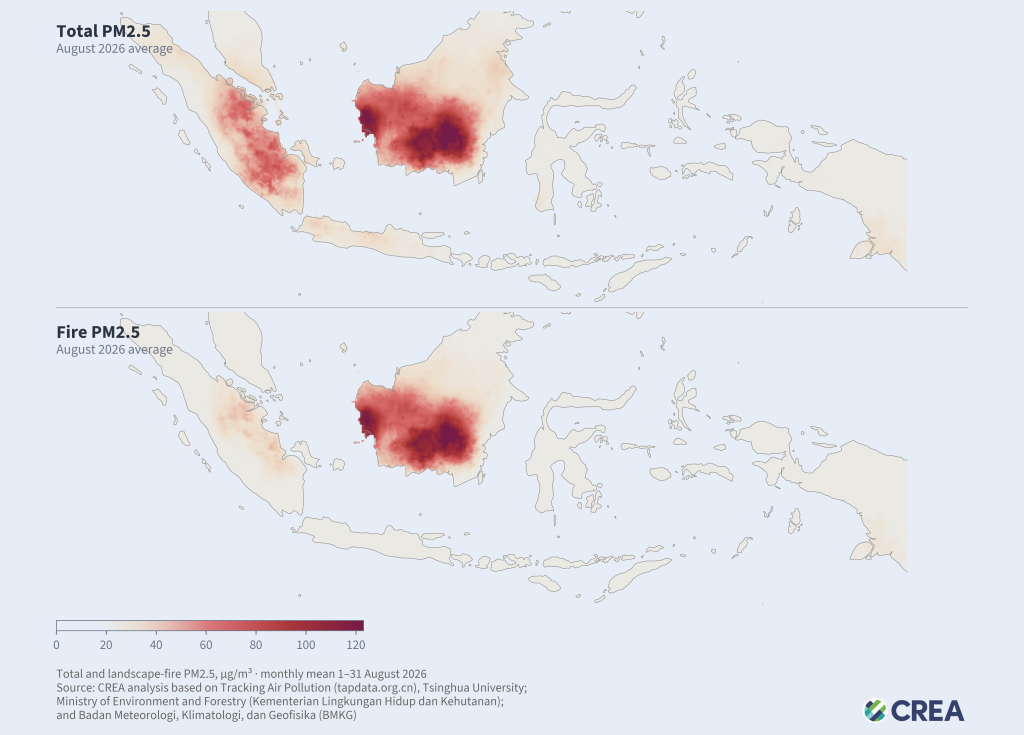
CREA’s analysis of Indonesia’s air quality and health impacts in August 2026 aims to highlight the escalation of this year’s forest and peatland fires in contrast to persistent air pollution issues in urban population centres.
While thick smoke and transboundary haze from karhutla, kebakaran hutan dan lahan in Kalimantan and Sumatra make national headlines, citizens exposed to sustained high levels of non-fire air pollution face an equally deadly crisis nearly year-round.
This moment presents Indonesia with an opportunity to demand a national mandate enforced by a unified government body — one that protects citizens’ rights to clean air every day of the year.
While fires rage across Kalimantan and Sumatra, Java’s chronic pollution quietly claims 70% of August’s total death toll
By absolute number of deaths, Java dominates Indonesia’s air pollution crisis, except that almost none of it comes from fire smoke. Home to 160 million residents (56% of Indonesia’s population), Java faces persistent, year-round air pollution rather than seasonal spikes. This ongoing issue stems from high-density emissions across fossil power generation, heavy manufacturing, large-fleet road transport, and, to a lesser extent, agriculture and waste management.
CREA estimates a total of nearly 1,600 deaths in the five most impacted provinces in Java — West Java (517), Central Java (421), East Java (352), DKI Jakarta (144), and Banten (139), with non-fire urban pollution accounting for 90% of these total deaths.
In contrast, West Kalimantan, Central Sumatra, South Kalimantan, Riau, and Jambi show dominant fire PM2.5 shares — between 72% and 99% of their attributable deaths. Without this year’s karhutla, these provinces would not even make the list since non-fire PM2.5 pollution contribution is considerably low.
Individual burden in Kalimantan is three to four times Java’s
Looking at deaths per 100,000 people rather than total numbers, the ranking becomes reversed. While provinces in Java are linked to higher absolute death counts due to their high population density, an individual living in Kalimantan faces a short-term mortality risk three to four times higher than a resident in Java.
This stark comparison exposes a profound environmental injustice.
Escalating Kalimantan and Sumatra karhutla drove national PM2.5 average to 29 µg/m³, despite steady non-fire pollution in Java
Kalimantan has been the epicenter of this year’s karhutla event, with air quality shown to deteriorate rapidly through August. Daily population-weighted PM2.5 concentration stood at 20 µg/m³ during the first week of August 2026, which then surged rapidly to 60 µg/m³ through the second week, before getting progressively worse, reaching 100 to 120 µg/m³ by the end of the month.
In Sumatra, the scale of fire contribution in PM2.5 levels has been considerably suppressed below 40 µg/m³ until mid-August. Levels then began to escalate during the last week of August, nearly matching underlying non-fire contributions and pushing levels to nearly 60 µg/m³ before tapering off toward the end of the month.
As for Java, where the majority of citizens reside, virtually all PM2.5 contributions came from non-fire sources, with only 4% fire share indicated for August. Levels remain consistent around 20 to 30 µg/m³.
At the national level, Indonesia’s population-weighted PM2.5 daily mean reached 29 µg/m³ with a 27% fire contribution that is modestly rising through the second half of August.
These spikes have severely exceeded the World Health Organization’s (WHO) 2021 Air Quality Guidelines, which set a 24-hour PM2.5 limit of 15 µg/m³ and warn that there is no safe level of pollution.
In August, tens of millions of Indonesians have been exposed to unhealthy to hazardous air pollution levels — peaking at 41 million on the 18th, closing at 36.4 million on the 31st
Tallying the month of August, both fire and non-fire PM2.5 sources combined at the national level shows a peak on August 18th, one day after Indonesia’s 81st year of independence. On this day, over 41 million Indonesian citizens (~15% of the national population) were exposed to air pollution levels categorised as ‘Unhealthy’.
At the end of August, the nationwide tally of exposure grew lower with 36.4 million (~13% of the national population) exposed to ‘Unhealthy’ and worse air pollution levels. About 30 million citizens were exposed to ‘Unhealthy’ levels. However, the total count of citizens breathing ‘Very Unhealthy’ levels rose to 4.2 million, and ‘Hazardous’ 2.5 million.
Looking more closely, Kalimantan has the highest proportion of people affected by ‘Unhealthy’ air quality or worse, peaking at 69% of the island’s total population, followed by Sumatra (40%) and Java (16%). In absolute terms, Sumatra and Java each saw around 25 million people breathing air rated unhealthy or worse on their worst August days (24.6 and 24.7 million), and Kalimantan 12.3 million.
August only marks the onset of the crisis
During severe El Niño years, notably 2015, 2019, and 2023, karhutla reached their climax in late September, October, and November. Anticipating karhutla is yet to reach its peak, without immediate government intervention, more areas and more people across the country would be impacted, putting more strain on the state budget to support disaster recovery.
On 28 August 2026, Indonesia’s Ministry of Health recognised the severity of the situation, and announced that over 10.6 million people across West Kalimantan, Central Kalimantan, South Kalimantan, East Kalimantan, Jambi, Riau, and South Sumatra have been affected. Separately, on 1 September 2026, the Ministry also declared that there have been 50,891 confirmed cases of acute respiratory infections (Infeksi Saluran Pernapasan Akut, ISPA), with 12,600 cases involving children aged 5 years old or younger.
These surges in respiratory illnesses place a tremendous strain on Indonesia’s healthcare system. According to the Ministry of Health’s hospital registry, the country has nine specialized lung hospitals (Rumah Sakit Paru). Seven are concentrated in Java, and only two in Sumatra. Kalimantan does not have a single one. A critical shortage of both pulmonologists and specialized equipment leaves citizens in the most severely impacted regions with minimal care.
Moving forward: Reforms on the right to a safe environment and clean air
Enactment of a national clean air mandate: Indonesia must institute legally binding and enforceable national ambient air quality standards, backed by a transparent and reliable monitoring network with coverage spanning from urban centers to remote regions (particularly high emissions locations), upholding the principle that every citizen deserves equal access to clean air. While the national ambient air quality is regulated under Government Regulation No. 22 Year 2021 on Environmental Protection and Management, implementation remains passive and reliant on political approval. To protect public health year-round, Indonesia needs a framework that sets actionable actions when levels are breached, authorises regulators to mandate industrial curtailments and ban land-clearing on corporate concessions, and enforces cross-sectoral accountability to drive decisions that restore air quality to safe levels.
Formation of a unified inter-ministerial body: Despite the Ministry of Environment holding the mandate for the national air quality oversight, their authority remains siloed. The major gap lies in passing, enforcing, and embedding binding clean air standards into other sectoral policies. Today, Indonesia’s energy, land-use, and economic decisions are still formulated without taking into account impacts on ambient air quality and safe limits for public health. A unified body would bridge this gap, establish cross-agency accountability, and ensure clean air targets guide decision-making.
Establish a multi-sectoral action plan for all emitters: Clean air policy should not treat karhutla and urban pollution as separate issues. Indonesia should expand its legal framework to hold all polluters strictly accountable to safe ambient air standards. For karhutla, this requires strict audits of fire hotspots within concession areas as the basis for investigating and prosecuting implicated corporations – delivering President Prabowo’s threat to immediately revoke permits, “cabut izin”.
Equally, for non-fire-polluting sectors across power, industry, and transportation, this requires strict enforcement of emission limits, mandatory interventions during high-pollution episodes, and legal liabilities beyond administrative fines for facilities that continuously breach safe air limits.
About the data
This assessment estimates the number of deaths brought about by short-term exposure to PM2.5 in Indonesia during August 2026 (deaths occurring within days of exposure) separated into a landscape-fire and a non-fire component.
Daily PM2.5 fields come from the Tracking Air Pollution (TAP) product developed at Tsinghua University. The monthly average field has been scaled to match measurements from 171 Indonesia’s ground monitors from the Ministry of Environment’s national network (133), the Agency for Meteorology, Climatology and Geophysics (26), and Provincial Environmental Agency’s reference sites (12).
The fields are population-weighted to province level and combined with short-term concentration–response functions chosen separately for fire and non-fire particles, and with provincial baseline mortality from the Global Burden of Disease 2023 (Institute For Health Metrics and Evaluation).
Supplementary information on methodology, references, and appendix is available in a separate document (accessible through this link).