
Authors: Xiaoli Zhang; Lizzie Frost
The 15th Five-Year Plan (FYP) marks a critical period for China’s energy transition and climate policy. China has committed to peak CO₂ emissions before 2030 and reduce economy-wide net greenhouse gas (GHG) emissions by 7–10% from peak levels by 2035. The next five years will therefore shape not only when emissions peak, but also how high the peak is and how much reduction is left for the following five years.
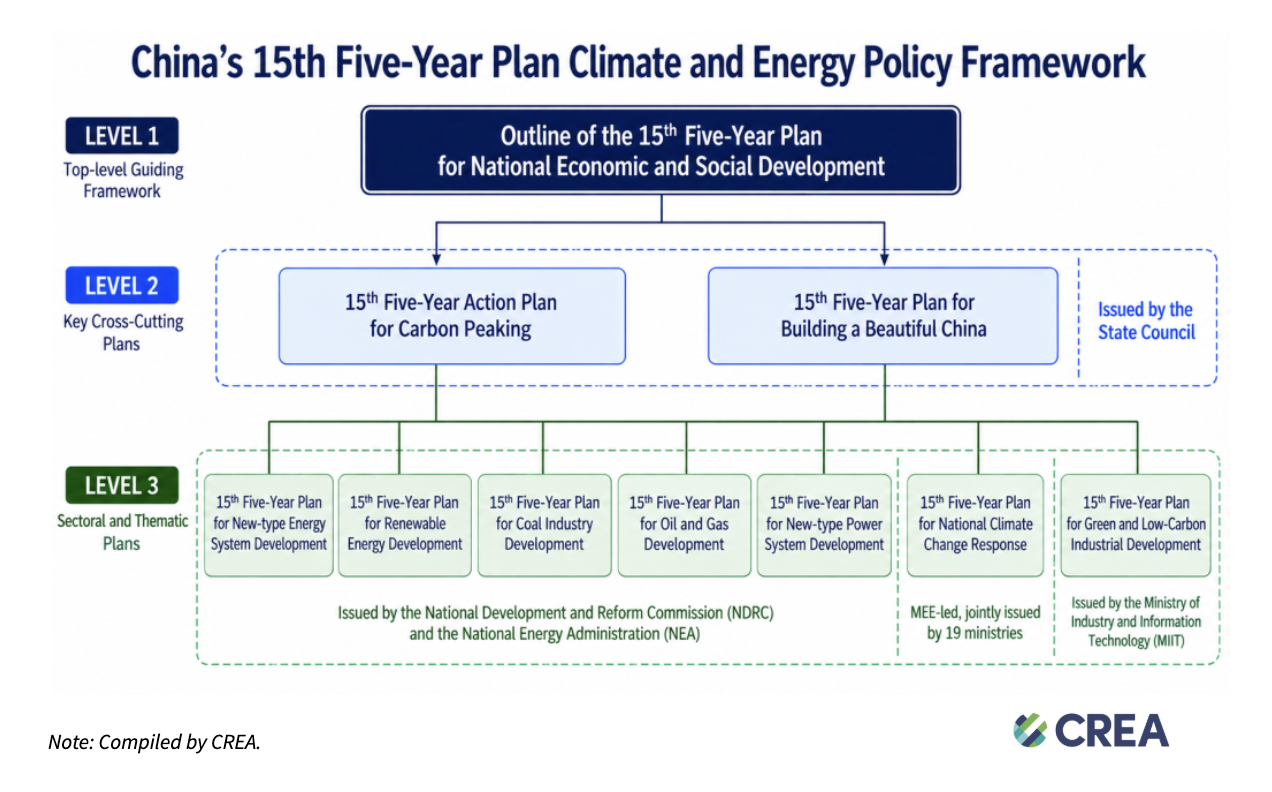
Since March 2026, China has rolled out a broad 15th FYP policy package. The national 15th FYP outline sets the top-level direction for 2026-2030, while the State Council plans on carbon peaking and building a beautiful China translate that direction into overarching climate and energy policy. The Ministry of Ecology and Environment (MEE)-led climate change plan develops climate governance. The National Development and Reform Commission (NDRC) and the National Energy Administration (NEA) set sectoral targets and measures in sectoral plans, including for the energy system, renewable energy, and coal. Together with other sectors, these documents form the main policy framework for China’s energy and climate transition through 2030. The 15th FYP documents were published much earlier in the five-year period than in previous cycles, providing a clearer policy picture, though some sectoral plans remain high-level, with important implementation details and practical targets still unspecified, which may partly reflect a more compressed timetable for stakeholder consultation.
Beyond the headline targets, the policy weight and stringency of China’s 15th FYP energy and climate plans are central to understanding how far they constrain fossil-fuel use, and what they imply for the country’s emissions trajectory.
Emissions: No absolute cap and no clear emissions pathway
The path to China’s 2035 target remains unclear. The plan requires CO₂ emissions to peak before 2030, but does not specify a peak year, peak emissions level, or rate of decline post-peak. This leaves the door open to a range of emissions pathways consistent with the targets. Because the 7–10% reduction in economy-wide net GHG emissions will be based on an unspecified peak, the timing, level, and accounting of that peak will determine the target’s actual stringency. The absence of an explicit annual or five-year emissions budget also makes it difficult to assess how the 2026–30 pathway aligns with the 2035 target.
The 15th FYP does not set a national absolute cap or budget for CO₂ or economy-wide GHG emissions. Its main binding target is a 17% reduction in CO₂ emissions per unit of GDP from 2025 to 2030, allowing emissions to grow if economic growth is close to the target. China’s recently revised carbon-intensity data also changes the baseline: the 15th FYP reported that carbon intensity had declined by 17.7% from 2020-25, based on revisions to the definition of the target and previously reported progress, while under the old definition, CREA’s earlier analysis found that it only declined by 12.4%. For other greenhouse gases besides CO₂, the climate change plan targets implementing projects that would deliver an emission reduction of 30 MtCO₂e by 2030, corresponding to only around 1% of China’s total non-CO₂ greenhouse gas emissions. Importantly, this does not require absolute reductions in total non-CO₂ greenhouse gas emissions, but reductions relative to project-specific baselines.
Sectoral measures add some specificity, with the national emissions trading scheme (ETS) moving towards total quota control in sectors where emissions are relatively stable. But most quantified targets remain intensity-based and do not ensure an absolute decline. For example, the new system plan targets a more than 10% reduction in CO₂ emissions per unit of power generation; this could still allow power sector emissions to rise by roughly 15% over 2025-2030 if generation grows 5% annually. The new plans call for more regular local emissions assessments and GHG inventories, which should improve emissions tracking.
Coal: Weaker constraints leave room for a high plateau
Coal consumption is no longer set on a clear downward path. The 2021 carbon peaking action plan stated that coal consumption would decline gradually during 2026–30 and called for strict controls on new coal power. The 15th FYP coal industry plan now aims for coal consumption to peak by 2030, without specifying a national coal-consumption cap, peak level or decline pace thereafter. This leaves room for coal use to keep growing or remain high for much of the period. The new power system plan calls for coal power to shift toward a supporting and regulating role, with some orderly retirement, while requiring planned coal projects to be completed. China’s coal-power capacity had already reached 1,285 gigawatts (GW) by July 2026, with new operating coal plants reaching the highest first-half-year level since 2016. The new provincial evaluation system could constrain provincial coal consumption, but its stringency remains unclear.
Even as coal power’s role in generation declines, greater use of coal as a feedstock could sustain overall coal demand. The coal plan calls for the ‘orderly expansion’ of coal feedstock use and supports strategic coal-to-oil and coal-to-gas bases. Compared with the tight controls during the 14th FYP period, this signals stronger policy support for using coal as a feedstock and for coal-based fuels. Coal-based chemicals can reduce dependence on imported oil and gas, but their expansion could offset part of the decline in coal demand and emissions from other sectors. CREA’s recent analysis found that coal use for chemicals was up 8% year-on-year in the second quarter of 2026.
Clean energy: Scaling up while strengthening system integration
Clean energy is increasingly framed as part of China’s energy security strategy as well as its decarbonisation agenda. The 15th FYP recognises that this requires more than adding renewable capacity: clean power needs to be used, renewables should replace fossil fuels beyond electricity generation, and a more flexible power system is needed.
By 2030, total renewable capacity is targeted at around 3.5 terawatts (TW), including more than 2.8 TW of wind and solar. Meeting this target would require a much slower pace of additions than seen recently and should be read as a minimum rather than a forecast. More importantly, the planning package shifts attention from how much renewable capacity is built to how much renewable energy is actually generated and used. The plan also targets 6,000 terrawatt hours (TWh) of renewable generation and a 50% non-fossil share of electricity generation by 2030. These targets are relatively conservative. A 50% non-fossil generation share in 2030 could still allow fossil generation to rise by around 11% from 2025 levels if total power generation grows by 5% annually.
China is already adding enough clean power capacity to more than cover electricity demand growth, but curtailment, grid constraints and dispatch rules limit the replacement of fossil generation. As a result, managing curtailment and making renewables more dependable are key aims of the 15th FYP policy package.
Yet, the new power system plan further weakens the targets for limiting curtailment. China reports curtailment and sets targets on the basis of ‘offtake rate’ (利用率), where, e.g., a rate of 90% implies 10% curtailment. The plan sets a national target for a new energy-utilisation rate of around 90%, lower than the earlier ‘reasonable rate’ of 95%. It also allows setting minimum rates between 85% and 95% for provinces, weaker than the 90–95% targets set earlier. This gives regions more room to add renewables, but also allows more generation to be curtailed where grids and flexibility lag.
The renewable energy plan for the first time sets a target for the average capacity credit of wind and solar capacity and more than 300 GW of additional reliable peak capacity by 2030. Capacity credit refers to the proportion of installed capacity that can be relied on during tight supply periods. In contrast, policy in the previous five years promoted ‘supporting’ coal power to meet peak loads and provide flexibility. Reliability is no longer framed as coal’s role alone, and the space left for coal in energy planning is narrowing. The new power system plan also expands storage, pumped hydro, demand response, and interprovincial support, although stronger market and dispatch reform will be needed to ensure these resources translate into greater renewable utilisation.
The plans place greater emphasis on renewable consumption through minimum consumption requirements, green certificates, green-power trading, and direct green-power connections. The renewable energy plan sets a quantified target for non-electric renewable energy use: renewable use for heating, fuels and feedstocks is targeted to rise by 150% from 2025 to around 150 metric tonnes of carbon equivalent (MTCE) by 2030, including 2 metric tonnes (Mt) of renewable hydrogen. The starting point is small, but together these targets signal a broader shift from adding renewable power capacity towards increasing the actual use of clean energy and replacing fossil fuels across power, industry, transport, and heating.
Transport decarbonisation as a bright spot
Amid the ambiguity surrounding emissions and coal, transport decarbonisation stands out as an area of ambition in China’s 15th Five-Year Plan framework.
New energy vehicles (NEVs) are targeted to reach 30% of the passenger vehicle fleet by 2030, under the State Council’s Carbon Peaking Action Plan. At the end of 2025, NEVs accounted for 12% of the vehicle fleet, meaning their number on China’s roads will need to roughly triple by 2030. That is ambitious, but achievable if recent sales growth continues, as NEVs represented almost 50% of newly registered vehicles in 2025. In July 2026, NEV sales set a new record, exceeding 60% of monthly vehicle sales for the first time.
Commercial transport is receiving greater attention, with the same plan targeting new-energy commercial vehicles to reach 25% of the fleet by 2030. The definition of ‘commercial vehicles’ covered by the plan remains unclear but likely includes public transportation, taxis, and freight. Looking at the narrower category of commercial freight vehicles, only around 4.3% of the fleet were new-energy vehicles at the end of 2025.
Heavy trucks have more specific targets. A new ministerial-level plan aims for new-energy heavy trucks to reach 20% of the total fleet – exceeding 1.6 million vehicles — and for 40% of sales by 2030. The sales target has already been surpassed: electric heavy-truck sales rose around 77% year-on-year in the second quarter of 2026, with the market share of electric trucks exceeding 45% of all new sales in June.
The bigger bottleneck for freight electrification is increasingly long-haul charging infrastructure rather than vehicle uptake. The plan seeks to develop 30,000 kilometres of zero-carbon road freight corridors equipped with around 3,000 heavy-truck charging and battery-swap stations.
This forms part of a broader zero-carbon transport corridor initiative, designed to expand rapid-charging and battery-swapping infrastructure along China’s busiest transport routes, enabling greater electrification of both freight and passenger transport.
The surge in global oil prices following shipping disruptions in the Strait of Hormuz has underscored the consumer and energy security benefits of electric vehicles for China. Electric vehicles displaced an estimated 33.7 Mtoe of oil consumption in the first half of 2026, driven by both rising NEV sales and greater utilisation of existing NEVs.
As China seeks to replace oil and gas in transport to strengthen energy security, the next phase of the transition will focus on sectors that are harder to electrify. Hydrogen and other green fuels feature across the plans as emerging priorities for aviation and shipping decarbonisation, though quantitative targets are lacking.
Looking further ahead, Hainan province’s plan to ban sales of internal-combustion-engine vehicles from 2030 could provide a blueprint for the longer-term evolution of China’s transport decarbonisation strategy.
Mixed signals on industrial decarbonisation: Decreased ambition for traditional industries; industrial parks and data centres positioned as new sources of clean electricity demand
Carbon intensity in large-scale industry is targeted to fall by at least 17% by 2030, while energy intensity is targeted to fall by 10% in the same period. These targets are both weaker than in the previous 14th FYP, which aimed for reductions of 18% and 13.5%, respectively.
The intensity targets for industry are set at the same level as the economy-wide targets, meaning industry is expected to improve at the same rate as the whole economy. This does not align with the government’s previous position that industrial carbon intensity should fall faster than the society-wide rate.
The 15th FYP for green and low-carbon industrial development restates the existing 2030 carbon peaking date for the industrial sector. There is no increase in ambition for steel and cement decarbonisation — critical industries which together account for around 30% of China’s carbon emissions — signalling no clear intent to accelerate electrification in the sector. This reflects the challenges in implementing the previous target for 15% of crude steel production to come from electric arc furnaces that has been missed by a wide margin.
Zero-carbon industrial parks are a prominent new industrial decarbonisation initiative outlined in the 15th FYP, reflecting a broader shift in China’s energy transition from prioritising clean energy expansion towards creating new sources of demand.
The parks aim to absorb growing renewable energy supply, relocate energy-intensive industries to areas with abundant clean power, and develop a ‘use green to make green’ model in which cleantech products are manufactured using green energy. Direct clean power supply is an important part of this model and represents a new mechanism for industrial decarbonisation.
Data centres are another priority for China’s industrial decarbonisation efforts, with plans to use clean electricity as the primary power source for new computing infrastructure by co-locating facilities with renewable energy developments and providing direct clean power supply.
China’s global climate role moves from participation to leadership
The 15th FYP also signals greater ambition to shape global climate governance, outlining China’s aim to ‘actively participate in and lead global climate governance.’ This is the first time a five-year plan has alluded to China’s climate leadership, and perhaps comes ahead of a rumoured Chinese bid to host COP33 in 2028.
The climate change plan calls for China to strengthen its discursive power by constructing a new narrative for global climate governance and significantly enhancing its international influence and agenda-setting ability. The plan suggests China will continue its current climate diplomacy strategy: uphold multilateral climate governance, shape global standards, and promote Chinese low-carbon technologies overseas, including by challenging trade policies it characterises as green protectionism.
Realising these leadership ambitions will require significant and sustained emissions reductions at home, alongside greater climate engagement abroad beyond clean-tech exports. Aligning domestic emissions-reduction targets with the Paris Agreement would strengthen the credibility of China’s international ambitions, while its global role could expand through greater leadership on climate governance initiatives with Global South partners.
The next five years present an opportunity for China to showcase itself as a responsible major power on climate change — it can do this by peaking CO₂ emissions, tightening controls on coal, and pursuing deep decarbonisation economy-wide.