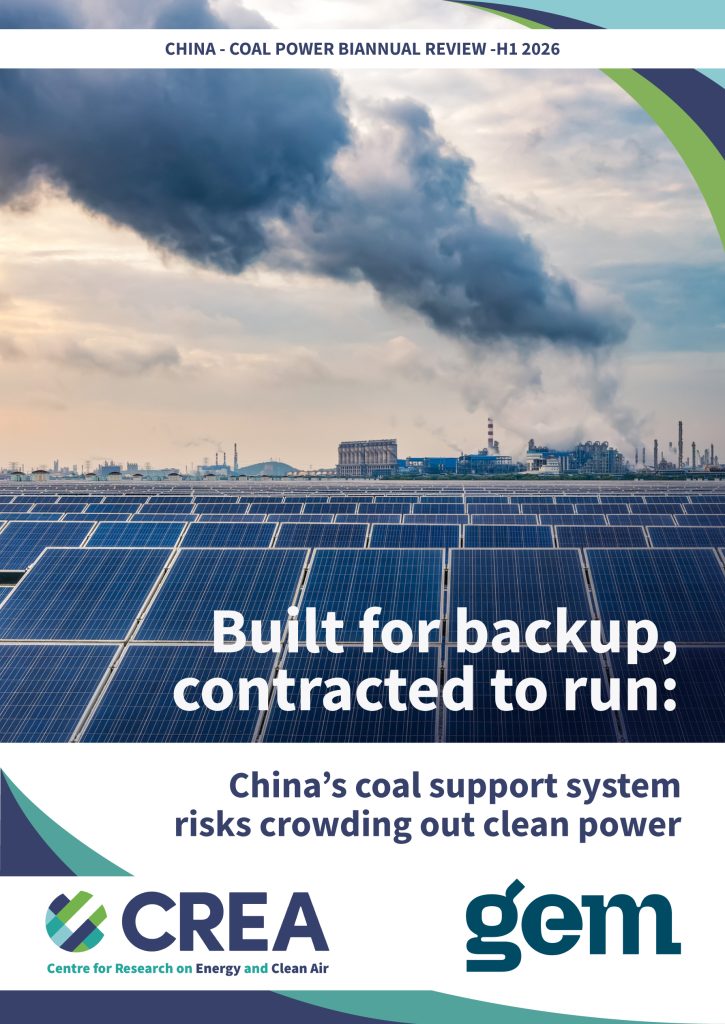
China entered the 15th Five-Year Plan period with the back end of its coal power pipeline still delivering substantial new capacity, even as policies began to place limiting signals on coal power generation through emphasis on electricity demand growth being met by clean power generation instead. The Centre for Research on Energy and Clean Air (CREA) and Global Energy Monitor (GEM)ʼs H1 2026 China coal power review finds that new coal power plants entering operation reached the highest first-half year level in a decade as China added 10 times more capacity than it retired.
What’s more, rapid coal power capacity growth deepened oversupply rather than responding to Hormuz-related supply disruptions, as reflected in rising clean power curtailment and falling coal power utilisation – China effectively wasted enough wind and solar to cover all new power demand in H1 2026.
Key findings
- New coal power plants entering operation in China reached the highest first-half year level since 2016, with 10 GW entering operation for every 1 GW retired, despite a policy shift towards tighter control of new project approvals. China commissioned 30 GW of new coal power, up 43% from last year, while retiring only 2.7 GW. Another 25.4 GW started construction.
- Coal power generation rebounded 3.4% year-on-year in H1 2026, reversing the 2025 decline. The rapid expansion of coal power capacity led to worsening oversupply, reflected both in the increase of wasted wind and solar generation and in falling utilisation of coal power plants.
- The rebound was not evidence of a broad return to coal following LNG shipping disruptions in the Strait of Hormuz. China’s combined domestic coal production and imports in fact fell by 1.4% year-on-year in H1 2026, rather than expanding in response to the external energy shock. Growth in clean energy supply and electrification helped offset the fall in oil supply and limit increases in fossil fuel consumption.
- Estimated wind and solar curtailment, including both reported and unreported curtailment, reached 360 TWh in H1 2026, up 49% year-on-year. Had this electricity been absorbed, the additional power supply could have met all demand growth and allowed coal power generation to fall.
- Long-term contracts continue to reserve a substantial share of limited electricity demand for coal power—coal generators in 2026 are still expected to sign annual contracts covering 60-70% of the previous year’s delivered electricity, turning a risk-management instrument into a barrier to renewable integration.
- CREA advises phasing out coal power-specific minimum requirements for medium- and long-term contracts in provinces experiencing renewable curtailment or oversupply to help coal transition from a baseload generator towards a flexible backup role.
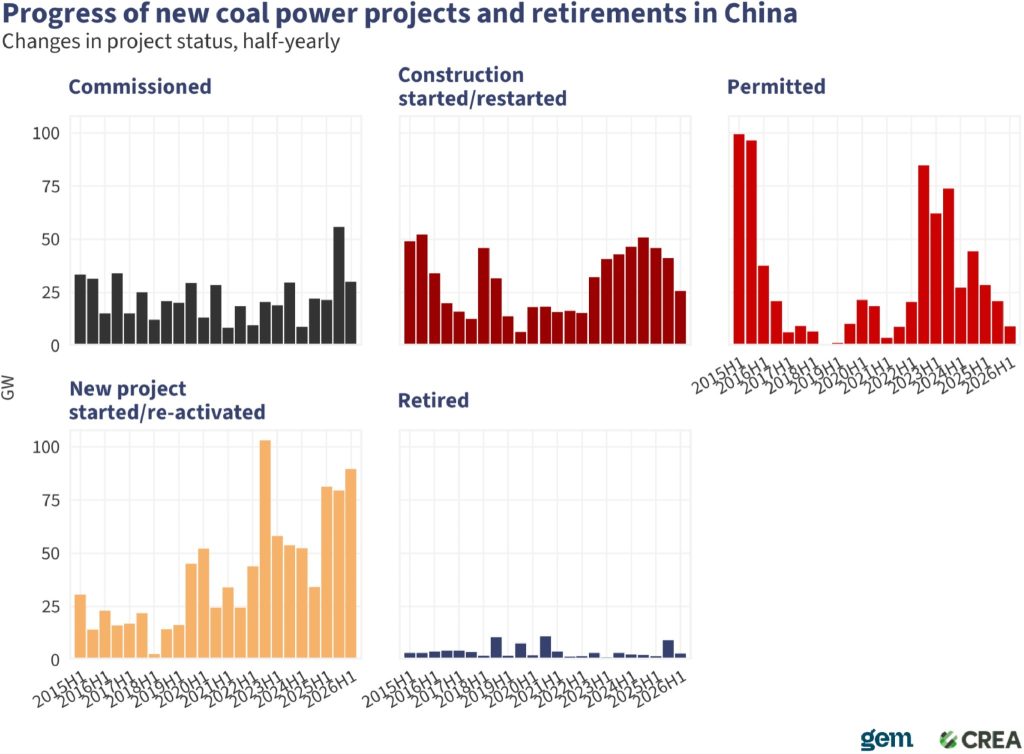
Figure — Progress of new coal power projects and retirements in China 2015-2026 H1
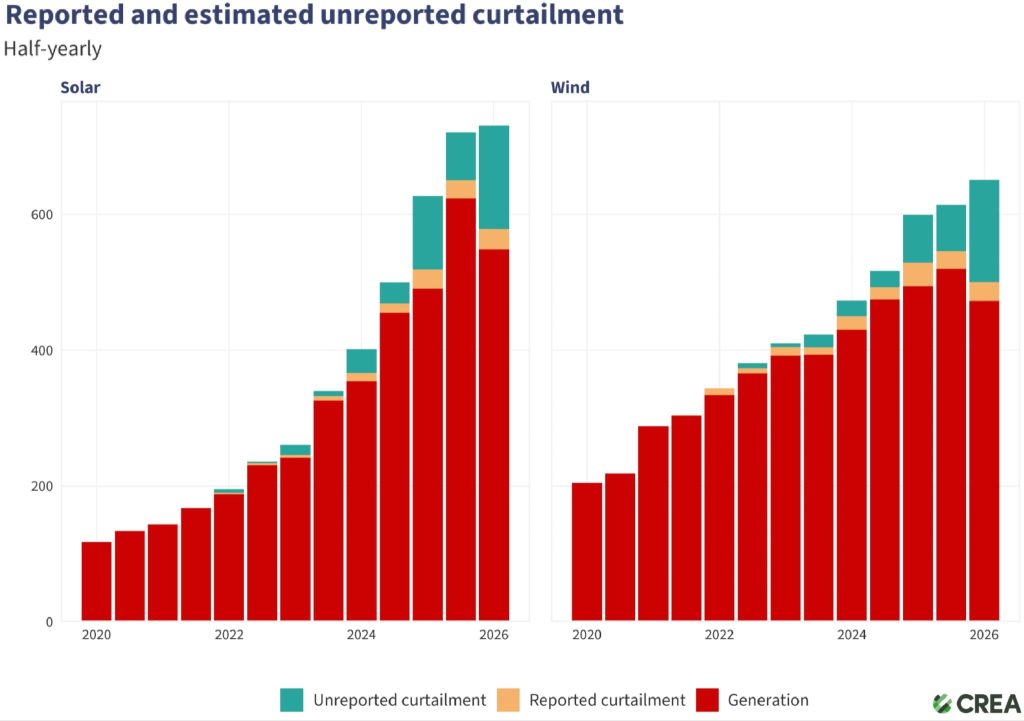
Figure — Reported and estimated unreported wind and solar curtailment in China in H1 2026
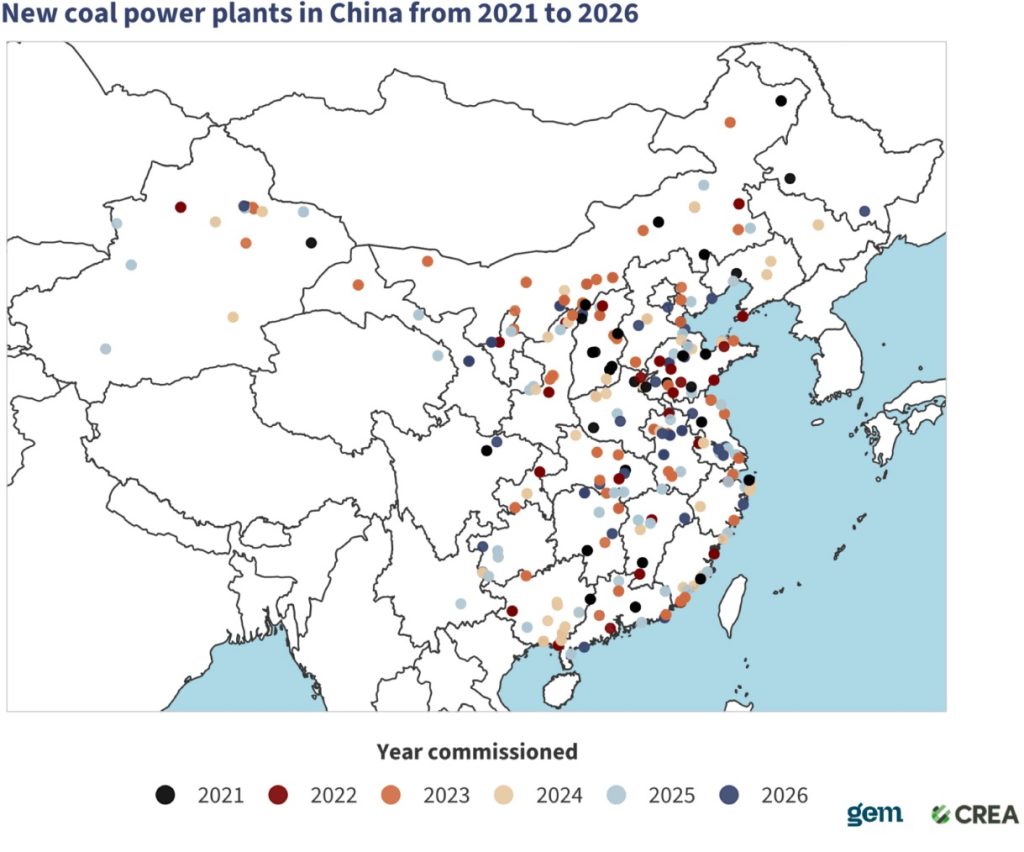
Figure — New coal power plants in China from 2021 to 2026 H1
Policy recommendations
- Set explicit peak years for power sector emissions and coal consumption. Publish a clear timetable for peaking power sector emissions and coal consumption during the 15th Five-Year Plan period. Align coal power planning and power market reform with these milestones so that additional clean energy generation supplies incremental electricity demand while coal power generation enters a sustained decline.
- End net growth in coal power capacity during the 15th Five-Year Plan period. Halt permits for new coal power projects and reassess projects that have already been permitted. Any exception should be based on a transparent provincial capacity-adequacy assessment showing that the identified reliability need cannot be met more efficiently through grid expansion, interprovincial trade, storage, demand response, or clean generation.
- Phase out coal power-specific minimum requirements for medium- and long-term contracts. During the transition, mandatory minimum contract ratios should be lowered or suspended in provinces experiencing renewable curtailment, prolonged zero- or negative-price periods, or system oversupply. Once these requirements are removed, contract volumes should be determined voluntarily by generators, electricity users, and retailers according to their risk-management needs.
- Separate payments for reliability from protection of coal energy sales. Capacity payments should reward dependable availability, ramping capacity, start-up performance, and delivery during periods of system stress, rather than installed coal capacity alone. China should move to a technology-neutral reliable-capacity mechanism that allows storage, demand response, and other flexible resources to compete on equal terms.
- End “retire-and-rebuild” coal power schemes. Coal units retired because they are ageing, inefficient, inflexible, or persistently underused should not create an entitlement to build an equal or greater amount of new coal capacity. Retirement policy should deliver a measurable decline in the coal fleet, rather than serving as a mechanism for replacing old plants with new ones. Where a genuine reliability or heating need remains, it should be assessed independently and met through the lowest-cost available combination of grids, storage, demand response, clean dispatchable resources, and heat-sector alternatives.