
Two provinces accounted for more than national net decline, while grid bottlenecks and curtailment threatened to waste clean power gain
By Lauri Myllyvirta and Qin Qi
Last year, China’s coal-fired power generation and power sector CO2 emissions fell for the first time in a decade. Record growth in wind and solar output had met most of the country’s rising electricity demand, whose growth eased after several years of unusually rapid expansion.
But the national turning point masked an uneven provincial picture: while 18 provinces reduced CO2 from the power sector, 13 recorded an increase.
Clean power growth was led by both large-scale clean energy bases in the north and west of the country, and major electricity demand centres in the east. All but three provinces increased the share of clean power in their energy mix. Yet much of the national decline in fossil generation was concentrated in Inner Mongolia and Shandong; together they reduced such generation by around 42 terawatt-hours (TWh), more than the national net decline.
China has been building wind and solar far faster than any other country. The next challenge is how much of that power the grid system can actually absorb. Had severe curtailment – that is, wastage – and other utilisation losses been avoided in 2025, wind and solar generation would have been around 13% higher, displacing a further 5% of coal-fired power generation.
At the same time, China’s clean power expansion has protected its energy supply in the face of the Strait of Hormuz crisis. Much of China’s seaborne imports of coal and gas, which could have been impeded by the crisis, end up in its the demand hotspots of its populous eastern coast. This is where more than a third of its clean power growth took place in 2025, lessening the impact of international fuel price hikes.
Two engines of China’s clean power boom
China’s cleanest provincial power systems are still largely shaped by geography, especially access to abundant hydropower resources. But the provinces driving the biggest increases in clean generation in 2025 were not necessarily those with the cleanest power mixes.
Regarding the power mix, Tibet and Qinghai had the highest shares of non-fossil generation, although Tibet’s power system is very small. In Yunnan and Sichuan, clean electricity still relies heavily on hydropower, with wind and solar so far playing a smaller role in reshaping the generation mix. Qinghai is different: its already-clean power system has been pushed further by rapid solar expansion.
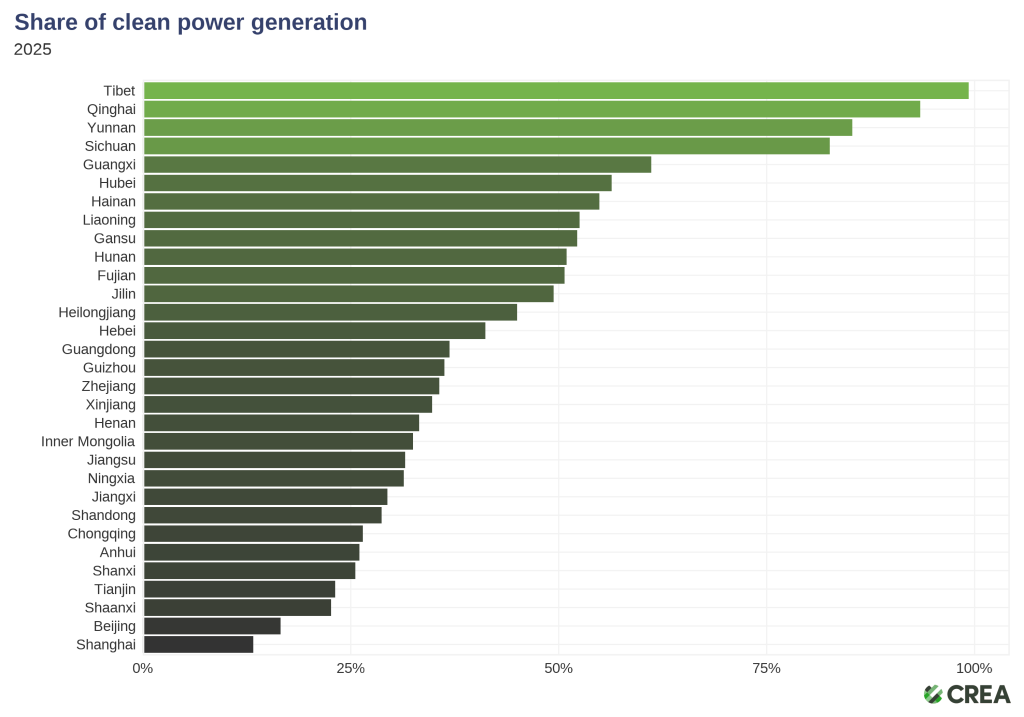
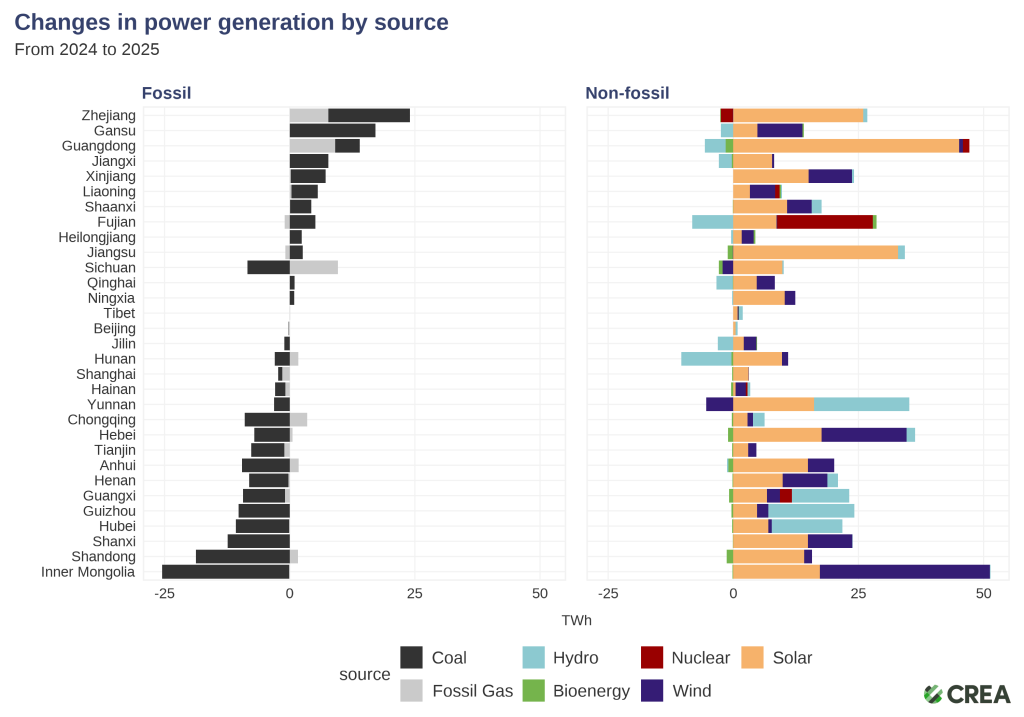
Regarding clean generation increases, two very different types of provinces saw the largest gains. These were resource-rich power-exporting bases that added large volumes of new wind and solar in northern and western China, and major electricity-consuming provinces in the east which expanded clean power supply to keep up with rising demand.
Inner Mongolia stood out most clearly: its clean power generation rose by around 51 TWh, far outpacing the increase in total generation and pushing fossil generation down by about 26 TWh. Hebei showed a similar pattern, supported by broad capacity additions in its Jibei clean energy base. Xinjiang also recorded a large rise in clean generation, but fossil generation still rose, partly because of continued, rapid coal power expansion.
Coastal demand hotspots also recorded large clean power gains, but these were not enough to cut fossil generation. Guangdong, Jiangsu and Zhejiang all ranked among the top provinces for clean generation growth, yet fossil output still rose in all three. Jiangsu came closest to covering new generation demand with non-fossil power; while Guangdong covered around three-quarters and Zhejiang about half. All three were also among the top five provinces for new coal power additions in 2025.
Where the power mix shifted fastest
Some of the sharpest shifts came from places not usually at the centre of China’s clean-power story. Guizhou, Tianjin, Hainan and Guangxi recorded the largest increases in share of clean power generation. In Tianjin, Hainan and Guangxi, the gains reflected strong growth in wind and solar, with Guangxi also benefiting from a broader mix of clean sources. Guizhou’s increase was the largest, but much of this was due to stronger rainfall and water availability boosting hydropower generation, rather than only new clean capacity.
Several fossil-heavy provinces also achieved notable improvements. Hebei and Inner Mongolia benefited from their position as hosts of major clean energy bases. More striking shifts came from Shanxi, Anhui and Henan. In these provinces, which remain deeply tied to coal, either as major producers or as industrial provinces close to eastern demand centres, clean power is beginning to erode coal’s dominance.
Gansu saw the largest decline in clean power share (a fall of around 1.3 percentage points), pointing to growing integration constraints. In other words, as curtailment pressures increased, Gansu turned to new coal power to provide system support. Coal generation and wind-and-solar generation increased by similar amounts as a result, limiting the improvement in the overall power mix. Tibet and Qinghai also recorded weaker clean-share performance. But once hydro is stripped out, the picture looks much stronger; the weaker hydropower output masked a significant rise in wind and solar.
Did clean power cut fossil generation?
The clearest test of provincial progress was whether clean power growth actually displaced fossil generation and cut emissions.
As mentioned, Inner Mongolia and Shandong stood out. Together they cut fossil generation by around 42 TWh, more than the national net decline. Inner Mongolia stood out most clearly, with a fall of 26 TWh. While Shandong cut around 17 TWh despite being one of China’s largest industrial provinces; Shandong did bring 3.8 gigawatts (GW) of new coal power online in 2025 but it also retired 3.3 GW.
Shanxi, Hubei, Guizhou, Guangxi, Henan, Anhui, Tianjin and Hebei all reduced coal and gas-fired generation. Some of these provinces have not usually been seen as leaders in power sector decarbonisation.
Zhejiang, Gansu and Guangdong recorded the largest increases in fossil generation. Xinjiang also saw actual fossil generation rise, showing how curtailment and utilisation losses prevent wind and solar from fully displacing fossil output.
The bottleneck: turning wind and solar into usable electricity
Reported curtailment rose sharply in 2024-25, and the fall in wind and solar utilisation was even larger than the official curtailment figures would suggest. Official utilisation rate data only counts system-related curtailment, excluding some lost generation linked to market trading, grid-connection conditions and other “special” causes.
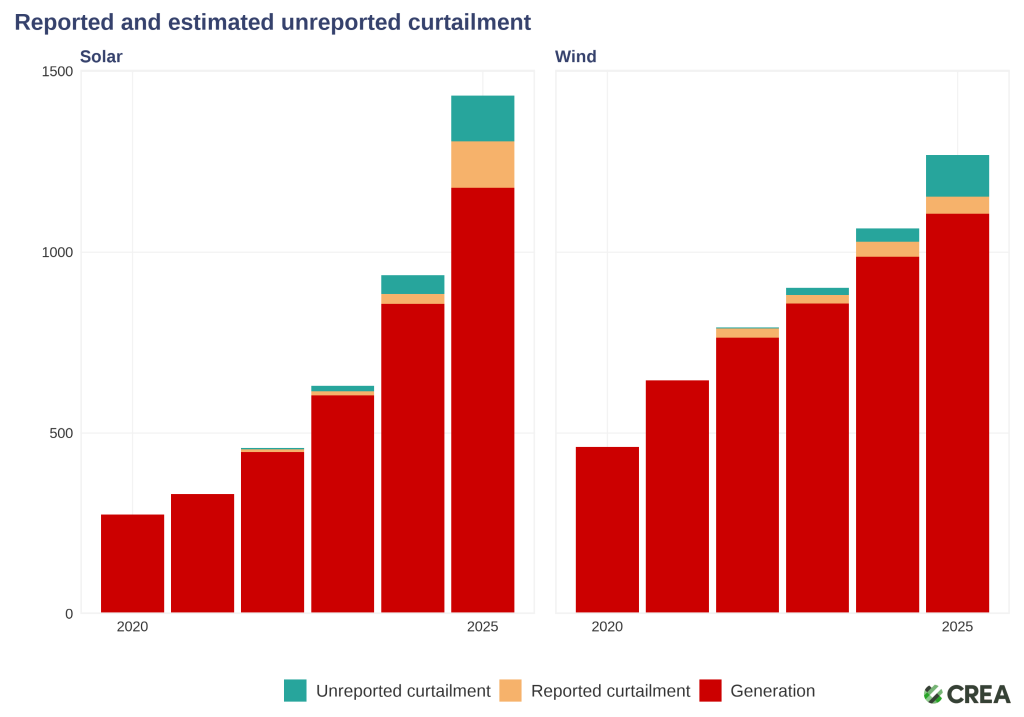
The underlying issue is that coal power plants, transmission networks and market mechanisms have not adapted quickly enough to the flexible operation needed to absorb China’s vast wind and solar capacity, including the huge additions made in 2025. The policy framework also became more permissive in 2024, with the relaxation of an important benchmark. The amount of potential electricity supply from wind and solar required to be utilised by the grid was dialled down from 95% to 90%.
Had these utilisation losses been avoided in 2025, wind and solar generation would have been 13% higher, enough to displace a further 5% of coal-fired generation. The value of the lost power generation is around USD 17 billion, which helps explain the boom in energy storage. There was 66.4 GW of new storage added in China in 2025, up around 52% year on year.
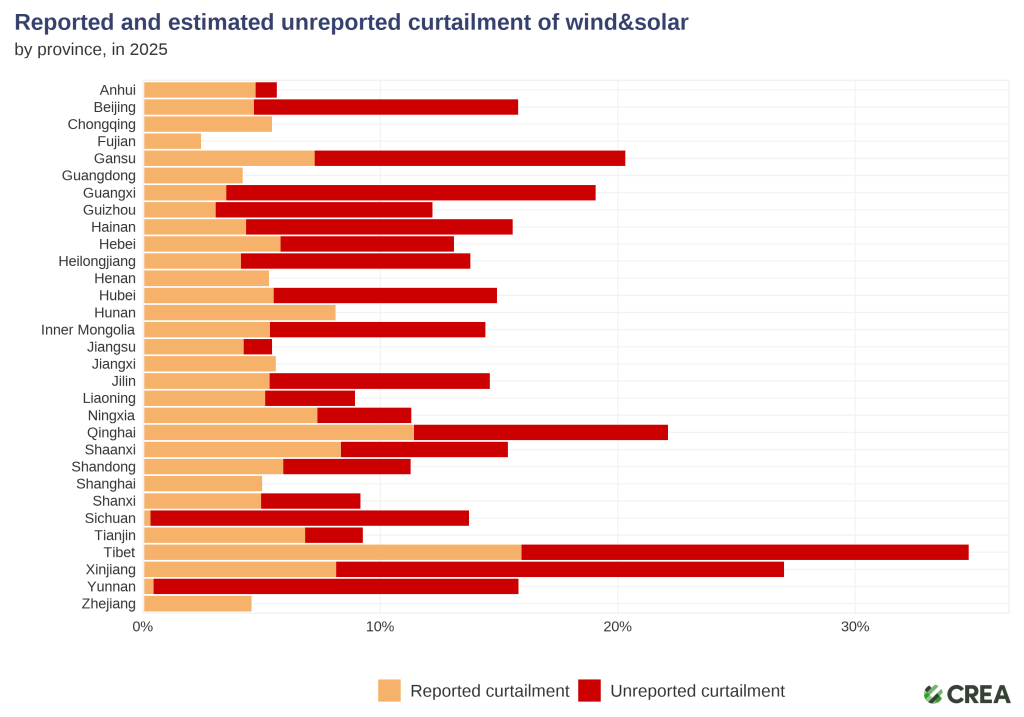
By volume, the biggest losses were concentrated in provinces such as Xinjiang, Inner Mongolia, Gansu, Hebei, Shandong and Qinghai. By rate, Tibet stood out most sharply, though its power system is small; Xinjiang, Qinghai, Gansu and Guangxi also recorded very high curtailment rates, both reported and estimated unreported. This helps explain why some of China’s biggest clean power provinces still struggle to reduce fossil generation: renewable capacity growth only translates into emissions reductions when the electricity can actually be absorbed by the system.
In contrast, Jiangsu, Anhui, Henan and Jiangxi have all pushed wind and solar above 20% of generation while keeping curtailment relatively low and avoiding large utilisation losses. Ningxia has come closer than most western provinces to combining a high wind-and-solar share with relatively low curtailment.
The central government has also recognised solar and wind curtailment as one of the central challenges of the energy transition. Guidelines published this April (Chinese original; English summary) have put stronger emphasis on promoting clean power consumption. In practice, this means operating coal plants more flexibly so they make room for wind and solar when renewable output is high, while providing backup when needed. The government is also investing heavily in long-distance transmission and encouraging new demand channels for renewable electricity, such as direct green-power supply, zero-carbon industrial parks and green fuels.
Clean power boosts China’s energy security
Clean power is reducing China’s exposure to imported fuels. As President Xi pointed out as early as 2024, China’s clean power boom is increasingly becoming an energy security story. China’s seaborne coal and gas imports for power generation are essentially all destined to a few regions: the Yangtze River Delta, Guangdong, Fujian, Hebei and Shandong.
Around 34% of the increase in clean power generation between 2020 and 2025 took place in these provinces themselves. Once you include wind and solar power from the north-west, delivered via long-distance transmission lines, that rises to 38%. In other words, more than a third of China’s clean power growth has gone to the parts of the country that are most exposed to imported fossil fuels, sheltering the country from the current fossil fuel crisis.
The total increase in clean power supply to these fuel-importing provinces was 730 TWh, equal to 1.5 times China’s liquid natural gas imports if all that gas had been used for power generation.
By expanding clean electricity in, or delivering it to, coastal demand centres, China can meet more of its power demand without turning to fuel shipped from overseas. In that sense, clean power has become both a decarbonisation tool and an energy-security asset.
Lauri Myllyvirta is senior fellow at Asia Society Policy Institute, China Climate Hub. He is also the lead analyst of Centre for Research on Energy and Clean Air.
Qin Qi is a China policy analyst with the Centre for Research on Energy and Clean Air.
Find the original article here on Dialogue Earth.