🇮🇩 Versi Bahasa Indonesia tersedia di bawah
By utilising advanced, top-down satellite remote sensing to bridge a critically sparse public ground-monitoring network, CREA has identified 29 NOx (nitrous oxides) point sources across Indonesia. This first-of-a-kind study also finds that the worst hotspots are mapped at coal & gas power complexes along with industrial clusters surrounding Jakarta and across Java as well as at nickel processing hubs in Sulawesi and North Maluku, showing that NOx pollution in Indonesia goes far beyond vehicle emissions and urban activities.
The study extends the Beirle et al. 2023 methodology, which had to date only enabled the identification of nine NOx point sources across Indonesia. To connect top-down satellite tracking with ground-level industrial architecture, this analysis categorises Indonesiaʼs 29 identified point sources into four distinct groupings: Urban, in close proximity to major power and industrial facilities; Large plant, small city; Nickel processing; and Mining.
Key findings
- Driven by a failure to decouple transport, power, and industrial growth from fossil fuels, Indonesia’s national NOx (nitrous oxides) emissions have surged by more than 50% between 2010 and 2022. Yet, the country’s national annual standard remains five times more lenient than World Health Organization safety guidelines.
- This study identified 29 NOx point sources across Indonesia — tripling the previous global catalogue:
- Nine of these hotspots sit in Indonesia’s most densely populated cities such as Jabodetabek, Surabaya, and Medan, stemming not only from local emissions, but also transboundary transport and heavily compounded by neighboring fossil power complexes and industrial boilers.
- Another nine sit in rural areas: NOx emissions from Java’s coal power complexes and cement kilns alongside Sumatra’s mega kraft pulp and paper mills is shifting the national air pollution burden onto rural communities.
- Six hotspots are driven by Indonesia’s aggressive nickel downstreaming, whose booming captive coal power capacity—which has grown by over six-fold—is creating NOx emissions in Sulawesi and North Maluku that eclipse those of the entire Greater Jakarta Metropolitan Area.
- The remaining five hotspots, mainly concentrated across the open-pit coal mining of Kalimantan, are driven by massive diesel machinery fleets, haulage transport, and decentralized mine-mouth power grids. These operate under broad environmental management frameworks rather than standardised, enforceable point-source stack emission caps.
- To foster economic growth while safeguarding clean air, the government must transition from passive, non-transparent compliance tracking to assertive intervention by requiring comprehensive monitoring and public reporting for large emitters.
- As the government implements its recently enforced emissions inventory and early warning system, policymakers must turn this data into active enforcement tools rather than mere advisories. Lasting air quality gains depend on prioritising strict standards over short-term fixes, mandating pollution control technologies, and maintaining rigorous compliance across all sectors.
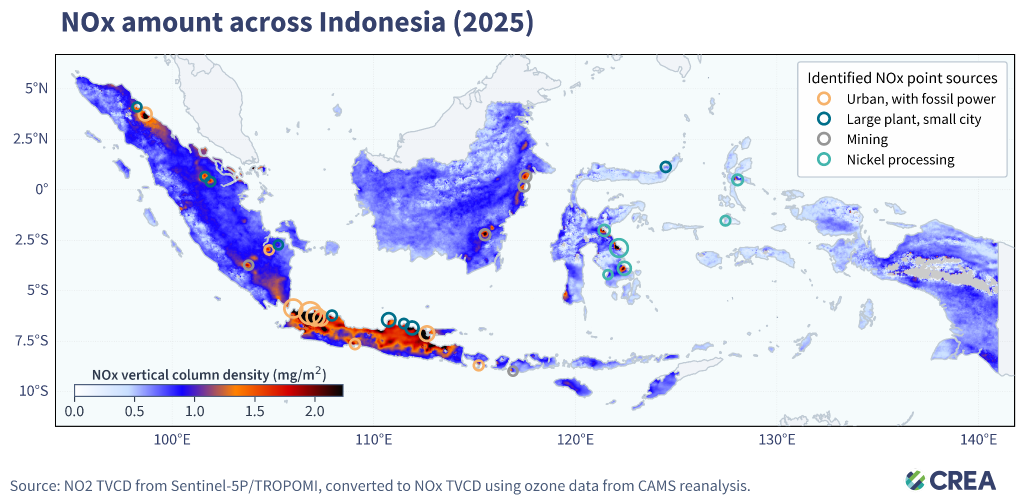
Figure — Indonesia’s average Tropospheric NOx Column Density in 2025
Policy recommendations
- Set and enforce stringent ambient air quality standards and emission limits. Enforcing these foundational pillars must take precedence over secondary measures. The 2023 Jakarta pollution crisis has shown the limits of reactive fixes, such as shutting down Suralaya coal power units 1–4, running random factory spot-checks, or mandating work-from-home policies (Kontan.co.id, 2023; Kompas, 2023; CREA, 2023). Growing air pollution across identified hotspots exposes clear gaps in regulation that can only be addressed by mandating effective air pollution control technologies and enforcing robust compliance across all sectors.
- Institutionalise health impact valuation in energy and industrial planning. Regulatory bodies must integrate the true societal externalities of air pollution — including healthcare expenditures, lost labor productivity, and environmental degradation — into national energy and macroeconomic models. Factoring in these impacts would clearly demonstrate that ambitious, climate- and health-aligned targets deliver far greater economic value for Indonesia.
- Use CEMS stack data, ground-level air quality monitoring and satellite-based insights to enforce compliance and exercise proper air quality planning. CEMS continuous stack-level monitoring data managed by the Ministry of Environment should automatically flag non-compliance, triggering automatic fines and notices, or site inspections. The framework recently established under the Ministerial Regulation of Environment No. 5 Year 2026 on provincial emission inventories and air quality management plans, can complement enforcement and inform policy interventions, bringing to light major contributing point sources and sectors that still lack oversight.
- Establish a real-time, publicly accessible emissions dashboard. Make public stack monitoring data and ambient air quality information available on an accessible platform to eliminate reliance on corporate self-reporting. Providing radical data transparency would affirm active regulatory enforcement, not only in major cities but also in remote areas near major industrial hubs that would foster public trust, and empower civil society to act as an independent oversight.
- Connect real-time monitoring to the recently enforced early warning response. When forecast air pollution levels reach the emergency thresholds, relevant agencies could enforce safeguards until air quality returns to safe levels. This connected system would allow them to quickly adjust emergency responses while giving the public timely alerts to take protective measures.