Türkiye’s reliance on fossil fuels is generating massive air pollution health costs both within the country and throughout the region. This report finds that fossil fuels account for more than half (52%) of Türkiye’s population exposure to PM2.5 air pollution. The cumulative health impacts are estimated to cost the Turkish economy approximately USD 55 billion each year, equivalent to 4.1% of national GDP in 2024. The pollution is also responsible for roughly 26,500 deaths per year in the country, including deaths from cardiovascular and respiratory diseases, lung cancer, stroke, and diabetes.
The impacts begin at the very start of life, with fossil-fuel-derived PM2.5 pollution contributing to an estimated 8,000 preterm births, 8,200 low-birthweight infants, 5,100 new cases of childhood asthma, and 6,500 emergency-room visits for asthma each year in Türkiye.
Beyond the estimated deaths each year in Türkiye, air pollution from the country’s fossil fuel emissions also contributes to deaths and economic losses in neighbouring countries. In 2024, these emissions were estimated to cause: 32,000 deaths and USD 2.1 billion in economic burden in Egypt; 1,700 deaths and USD 0.2 billion in economic burden in Syria; 800 deaths and USD 0.8 billion in economic burden in Iraq; 500 deaths and USD 4.5 billion in economic burden in Israel; and 400 deaths and USD 1.5 billion in economic burden in Greece.
Türkiye currently has no national ambient air-quality standard for PM2.5, despite the substantial health burden associated with exposure to the pollutant.
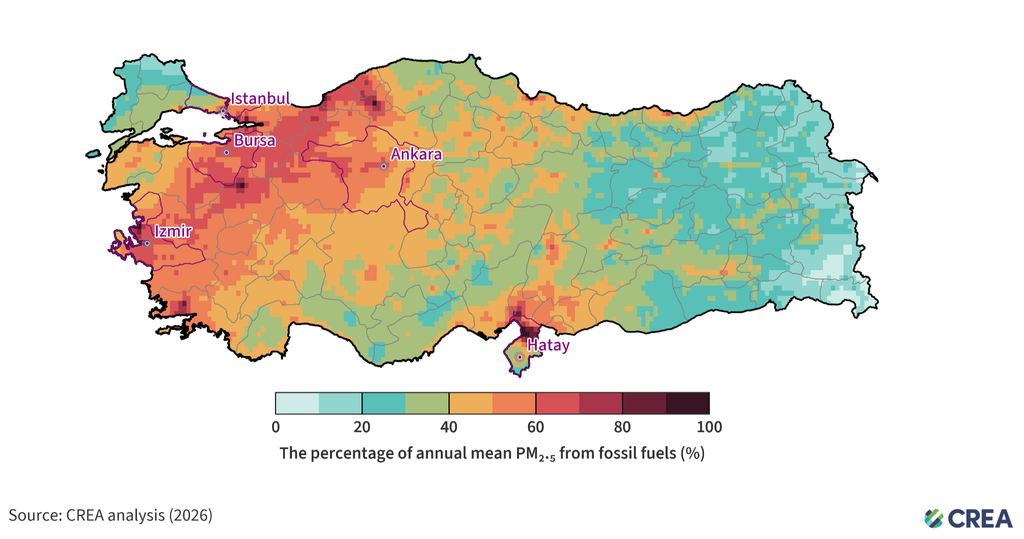
Figure — The percentage of annual PM2.5 emissions in Türkiye’s fossil fuel emissions, using the EMEP emission inventory and EMEP MSC-W chemical transport model
Key findings
- Türkiye’s fossil fuel emissions (from domestic sources as well as international aviation and shipping) account for 52% of population exposure to PM₂.₅ nationwide.
- PM2.5 pollution attributable to Türkiye’s fossil fuel use is responsible for approximately 26,500 deaths in the country every year, including deaths from cardiovascular and respiratory diseases, lung cancer, stroke, and diabetes.
- Children are among the most affected, with fossil fuel-derived PM2.5 pollution contributing to an estimated 8,000 preterm births, 8,200 low-birth-weight infants, 5,100 new cases of childhood asthma and 6,500 emergency room visits for asthma each year.
- The cumulative health impacts of fossil fuel-derived PM2.5 pollution are estimated to cost the Turkish economy approximately USD 55 billion each year, equivalent to 4.1% of national GDP in 2024.
- Transboundary pollution attributable to Türkiye’s land-based fossil fuel emissions also leads to thousands of deaths in five neighbouring countries, with estimated economic burden per year (as of 2024) reaching USD 2.1 billion in Egypt (3,200 deaths), USD 0.2 billion in Syria (1,700 deaths), USD 0.8 billion in Iraq (800 deaths), USD 4.5 billion in Israel (500 deaths), and USD 1.5 billion in Greece (400 deaths).
- Türkiye currently has no national ambient air quality standard for PM2.5, despite the substantial health burden associated with exposure to the pollutant. Reducing fossil fuel use and emissions across Türkiye’s energy, transport and industrial systems would deliver substantial air quality and public health benefits by reducing exposure to PM2.5 and preventing associated illness and deaths.
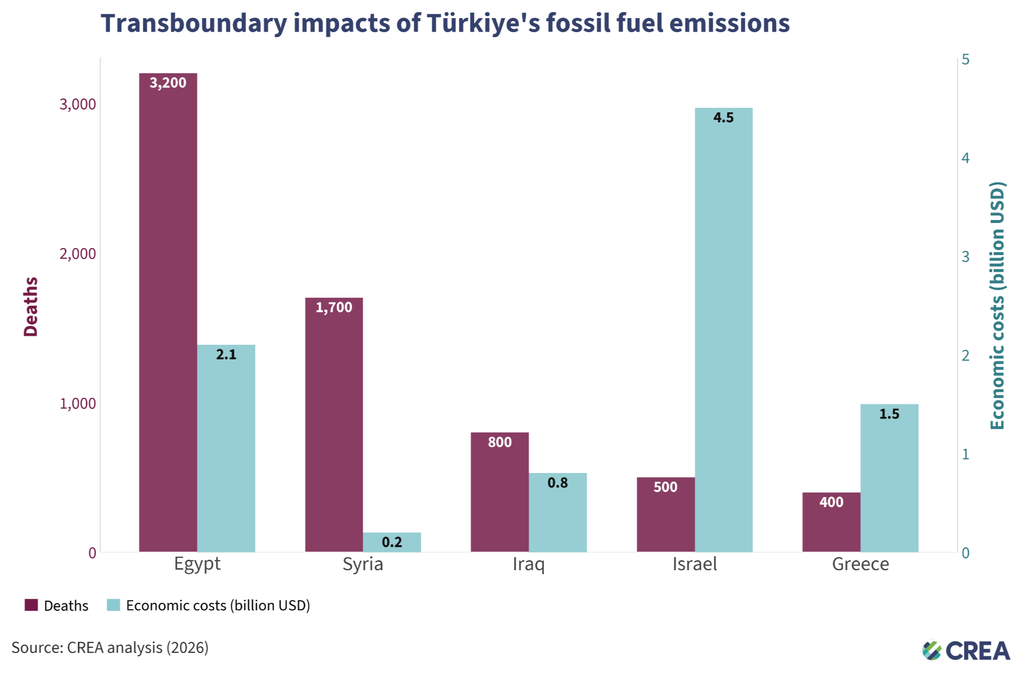
Figure — Annual deaths attributable to Türkiye’s land-based fossil fuel emissions in the five most affected countries, based on 2024 emissions