
Authors: Lauri Myllyvirta (CREA) and Victor Ponsford (Secure Energy Project)
October broke records at both ends of the climate story: it was the hottest on record, but also saw several countries sail past their clean energy production records, highlighting strong growth in deployment amid the second fossil fuel crisis of the decade.
Highlights
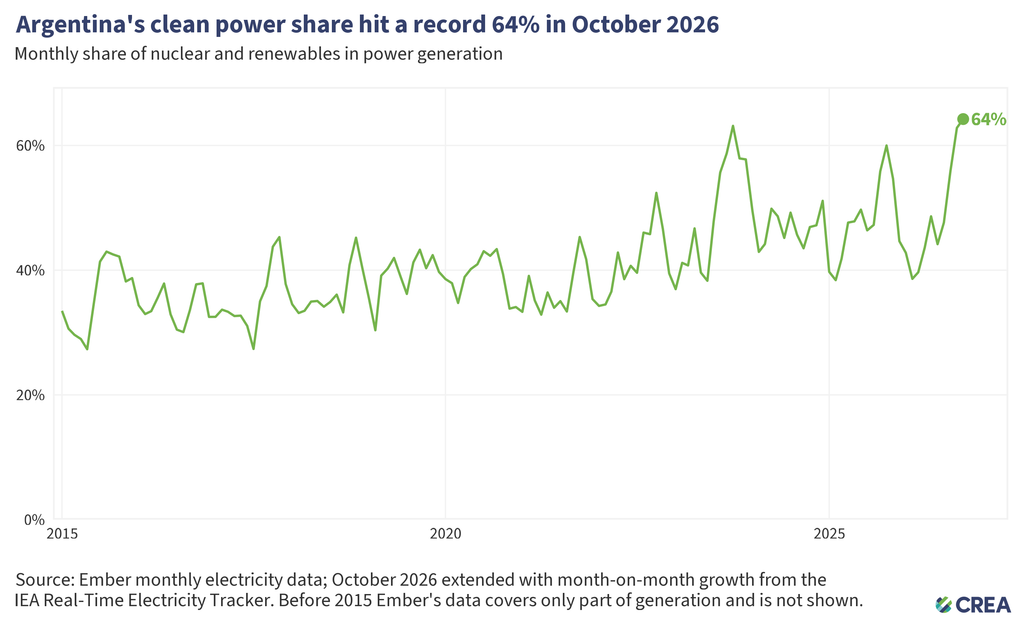
- Grids tan-go green: this month, Argentina got a record 64% of its electricity from clean sources compared to a previous record reached in 2023.
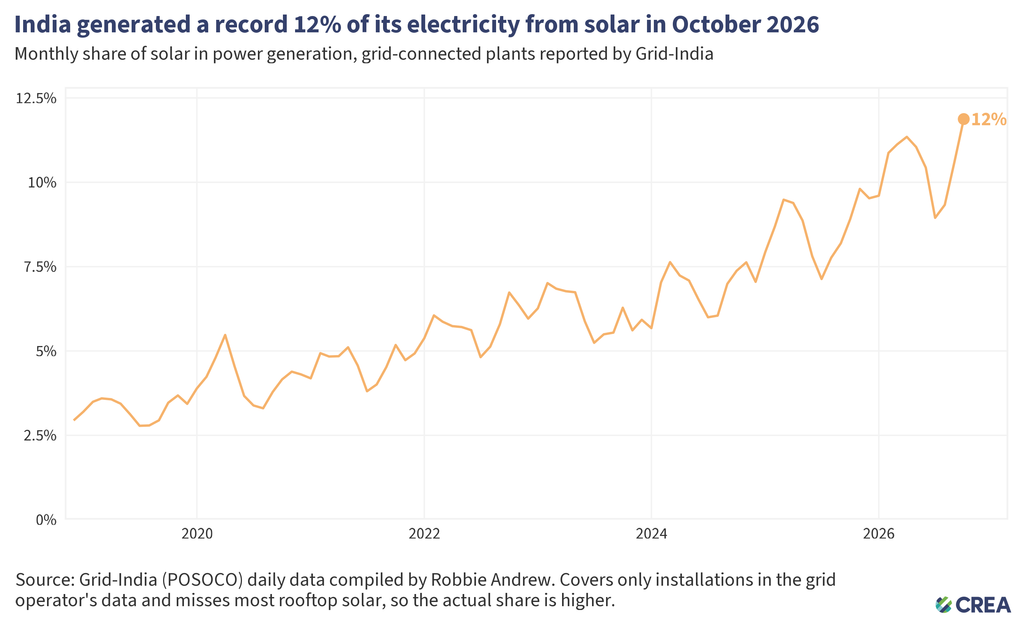
- Sun-sational: India scored a record 12% of its electricity from solar, a significant number given it is one of the biggest consumers of electricity in the world, and among the fastest growth markets. India’s solar power generation was equal to the total power generation of Australia or Italy during the same month.
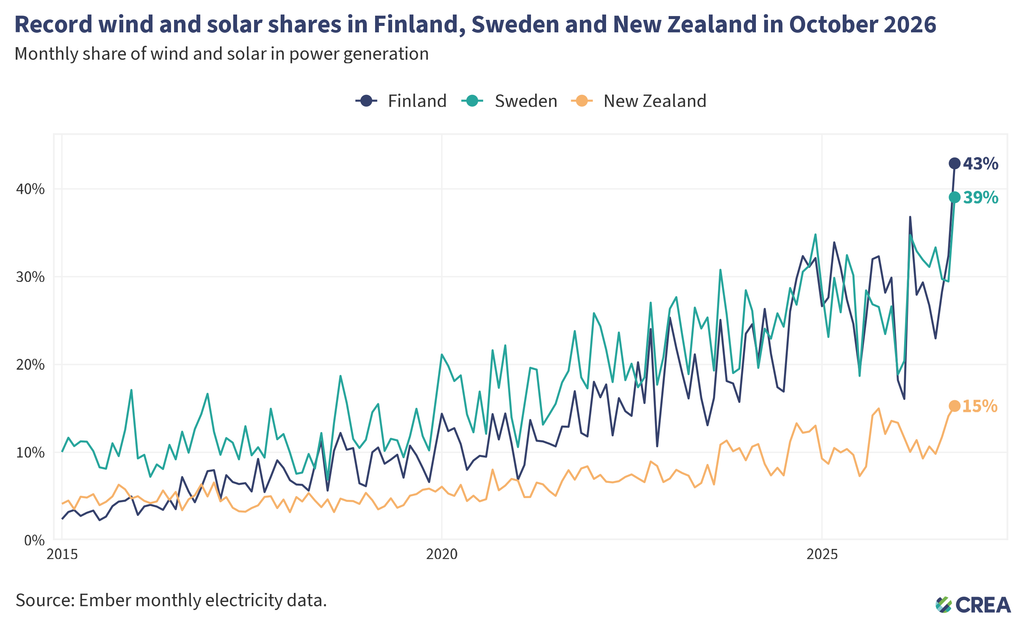
- WInds of change: Wind and solar hit record shares in Finland, Sweden and New Zealand. In Sweden, wind overtook hydro to become the largest source of power for the first time.
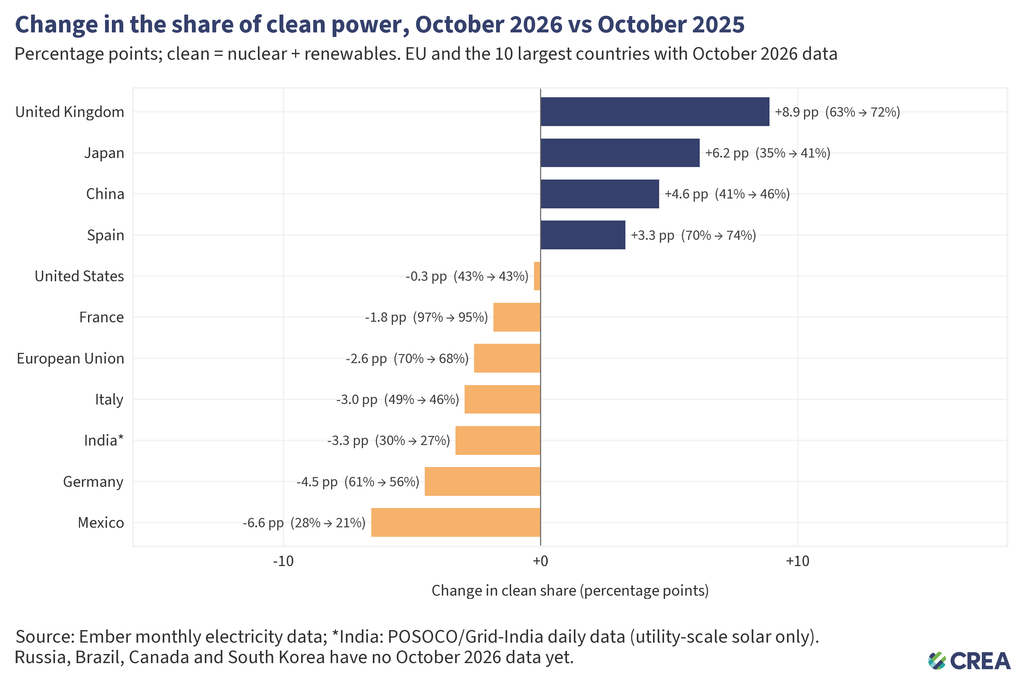
- Clean power acceleration: UK, Japan, China and Spain achieved the largest increases in the share of clean electricity, while Mexico, Germany and India saw the largest drops
This is the first edition of our monthly highlights, covering October 2026, the latest month with available data.
Putting the records in context
Wind overtaking hydro in Sweden highlights strong clean energy growth and diversification of the clean energy portfolio. Nordic hydro is one of northern Europe’s key sources of flexible power when demand peaks. But after an exceptionally dry year, Nordic reservoirs are well below normal, and southern Norway’s hit their lowest in some 30 years this summer. Every hour wind carries the load keeps that water in the reservoirs for winter peaks, when gas would otherwise set the price. With Europe’s gas storage also low and gas prices high, that matters.
Finland’s wind capacity more than tripled between 2020 and 2024. In October, wind supplied a record 42.2% of Finland’s power. Alongside nuclear, that let Finland shut its last coal plant last year.
Much has been written about Argentina’s plans to produce more oil and gas, and Vaca Muerta keeps breaking output records. Less noticed is what’s happening at home. Clean power supplied a record 64.2% of Argentina’s electricity in October. The greener the grid, the less gas Argentina burns for power, and the more its oil and gas boom depends on exports. The timing is awkward. The IEA expects the oil market to tip into surplus this quarter, with a bigger glut in 2027, and the LNG glut has been delayed, not canceled. Investors who banked on crisis-era prices could be left out of pocket.
Wind and solar supplied a record 41% of UK power in the first nine months of this year, against 25% from gas. The UK has saved an estimated £5.9bn in gas imports since the Hormuz crisis began thanks to clean energy.
China’s fossil power generation fell 7.3% in October, the fourth monthly drop in a row. Solar and wind output rose by a third and nuclear by a fifth. That leaves thermal generation slightly down for the year so far, which would make 2026 the second annual fall in a row. The catch is that China added a record 58.7GW of new thermal capacity, mostly coal, in the first eight months of the year, with no increase in coal power generation, signaling worsening overcapacity.
The share of clean power dropped in Germany, even if solar output was up around 40% last October, as wind and hydro fell. Then came a cold, still, grey spell at the end of the month, a so-called Dunkelflaute, that saw coal and gas plants increase output. Germany has work to do to build clean energy, storage, flexible demand and interconnection to get through a windless week without falling back on fossil fuels. Grid, grid, grid should be the mantra in Berlin.
India set a solar record in October, but still burned far more coal. El Niño weakened the monsoon, which cut hydro output while pushing up demand. Solar is growing fast, but India needs storage and more wind to stop a weak monsoon turning into a coal surge.
Across the OECD, clean power growth met the increase in power demand but not by much, with total fossil fuel generation inching down 0.6% and gas up 0.3% in the first nine months of the year. In a year when the Hormuz crisis more than doubled LNG prices, every gain for wind and solar eases pressure on the gas market, and we could have used much more of them.
Monthly records are partly about the season and the weather, as these set generation and demand. Most signals are pointing towards clean energy delivering an ever greater share in the energy mix. Solar has set a new record somewhere in the world every month since January 2025. If the world’s power mix is a symphony, the clean section keeps hitting new highs, and solar is setting the tempo.
About the data
The primary data source is Ember monthly electricity generation data, downloaded 18 November 2026. It covers individual countries plus EU, OECD and World totals.
All-time highs are the highest share in each country’s monthly record. Some series, including the World, OECD, India and South Korea, start in 2019. For these, a record means the highest since 2019.
Coverage: October data is available for 45 countries and regions so far. More will be added as national figures are published, so this list may grow.
Argentina: October figures extend Ember’s data using month-on-month growth from the IEA Real-Time Electricity Tracker.
Definitions: clean power is renewables plus nuclear. Shares are of total electricity generation. A record counts only where the source supplies at least 1% of generation.
| If you enjoy this kind of data-driven analysis of the most important current developments in global energy and air quality, subscribe to CREA INSIGHTS |