Air pollution is no longer just an environmental concern in India; it is a primary determinant of public health, as millions face chronic exposure outdoors, at home, and at work. Health risks include respiratory, cardiovascular, and metabolic diseases and vary by pollutant type, exposure concentration, and duration (Sekar et al., 2025).
Evaluating these health impacts is essential because of India’s large, growing population, rapid urbanisation, industrial growth, and complex emission profiles. Over the past 50 years, health research has grown significantly and provided valuable insights into environmental health risks. However, published studies vary widely in methodology, scope, and exposure assessment tools, ranging from stationary monitoring stations to satellite imagery and chemical transport models. Consequently, it is often hard to compare findings across studies. Localised research rarely reflects national population risks, and critical pollutants or health outcomes remain understudied.
To address these gaps, this brief synthesises 184 published epidemiological studies on air pollution and human health in India from 1975 to 2025. It examines how this body of evidence has evolved, including exposure settings, monitoring approaches, geographic distribution, institutional involvement, and funding landscapes, and highlights key exposure-health associations to inform evidence-based policy and future research priorities.
Summary
- Strong overall evidence of adverse health associations: Of the 184 epidemiological studies reviewed (1975–2025), 169 (91.8%) reported at least one positive association between air pollution exposure and a health outcome.
- Government-supported research: The vast majority of scientific projects in India are supported by central ministries and public institutions—including Ministry of Environment, Forest and Climate Change (MoEFCC), Ministry of Health and Family Welfare (MoHFW), Indian Council of Medical Research (ICMR), Central Pollution Control Board (CPCB), All India Institute of Medical Sciences (AIIMS), Department of Science and Technology (DST), University Grants Commission (UGC) and Council of Scientific and Industrial Research (CSIR). Government-backed research naturally makes up the bulk of the epidemiological evidence in India, with 44 of 46 government-funded and 77 of 81 government-affiliated studies documenting clear adverse health impacts.
- Range of health outcomes: Mortality was assessed across 16 studies. Among the disease outcomes, respiratory diseases were the most frequently studied (86 studies), followed by cardiovascular diseases (11 studies). Other studies examined diabetes, pregnancy-related complications, low birth weight and impaired child growth, neoplasms, haematological disorders, neurocognitive and mental health disorders, metabolic disorders, sleep disorders, ocular diseases, chronic kidney and bone diseases, and morbidity.
- Geographical coverage: Studies covered 18 states and Union Territories, alongside national and multi-state research. Delhi had the highest number of studies (26), followed by Punjab (13), Maharashtra and Uttar Pradesh (11 each), West Bengal (10), Tamil Nadu (9), Karnataka (8) and Telangana (7).
- Rural health evidence: 38 of the 40 studies covering rural populations reported at least one adverse health association.
- Multiple exposure settings: Studies examined ambient, household, indoor and occupational air pollution, covering exposures from outdoor sources, cooking and heating fuels, indoor environments and workplaces.
- Evidence across multiple pollutants: Studies investigated particulate matter and its components, including black carbon, organic carbon and heavy metals, alongside gaseous pollutants such as nitrogen dioxide (NO₂), sulphur dioxide (SO₂), ozone (O₃) and carbon monoxide (CO), and volatile organic compounds (VOCs).
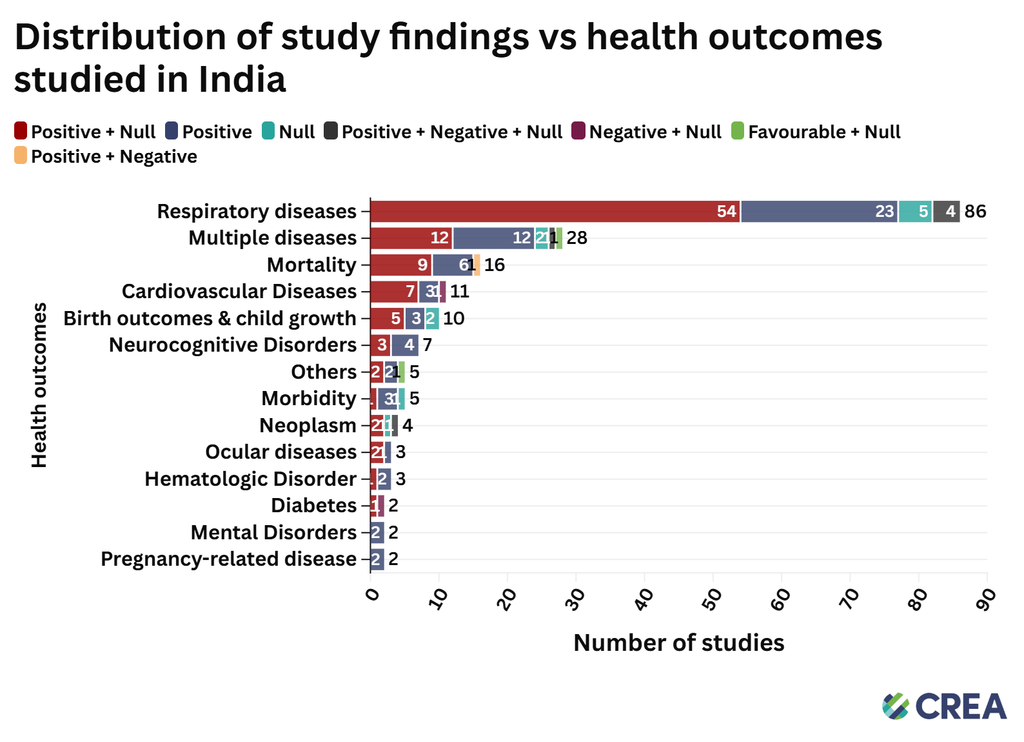
Figure — Health burden-wise distribution of study findings
Policy priorities
The substantial body of epidemiological evidence linking air pollution exposure to adverse health outcomes reinforces the need to make exposure reduction a central objective of India’s air pollution management policies. Reducing health risks requires lowering pollution concentrations across both ambient and indoor environments, rather than focusing on a single exposure setting or pollutant.
India’s National Ambient Air Quality Standards (NAAQS), last revised in 2009, need to be updated to reflect current scientific evidence and public health considerations. This should be accompanied by expanded monitoring coverage through both Continuous Ambient Air Quality Monitoring Stations (CAAQMS) and Online Continuous Emission Monitoring Systems (OCEMS), to improve the assessment of ambient pollution levels and industrial emissions. Stronger ambient air quality standards must also be supported by stricter and enforceable emission standards for major pollution sources, including industries and thermal power plants. Clear, time-bound emission reduction targets should be established for individual sectors, with defined implementation timelines and effective compliance monitoring.
Equally important is reducing indoor air pollution by accelerating the transition away from solid fuels, including biomass, coal and dung, for household cooking and heating, while ensuring access to cleaner energy alternatives. Air pollution management must therefore adopt an integrated approach that addresses emissions across sectors and exposure settings. Ultimately, reducing population exposure to air pollution is essential to protecting public health and lowering the associated disease burden.