September 2026 marks five years since Chinese President Xi Jinping pledged that “China will step up support for other developing countries in developing green and low-carbon energy, and will not build new coal-fired power projects abroad.” (Xi, 2021). Since then, the Chinese government has formalised the pledge through the 14th Five-Year Plan for a Modern Energy System, while developing a strong green overseas investment policy framework (NDRC, 2022).
More recently, the 15th Five-Year Plan, published in March 2026, outlines China’s ambition to demonstrate global climate governance leadership through deepening South-South cooperation and by providing affordable clean-energy technologies as “global public goods” (NPC, 2026). The subsequent sectoral-level plan for the Development of Renewable Energy lays out China’s renewed ambition to promote international cooperation on renewable energy to support the global transition and facilitate the free flow of Chinese green technologies in the global market. (NDRC, NEA, 2026).
For China to showcase itself as a responsible major power on climate change, it is vital that the country demonstrates its actions to achieve both domestic and global commitments over the next five years. The remaining China-linked overseas coal pipeline must be converted or cancelled before construction begins, while China should work closely with host countries with existing coal projects to manage a stable transition away from fossil fuels.
That is why CREA and the People of Asia for Climate Solutions (PACS) have tracked the implementation of China’s 2021 pledge through a series of annual reports analysing the evolution of China-linked coal power projects overseas.
Key findings
- In the five years since China’s 2021 overseas coal pledge, 67% of the coal power capacity planned at that time has been cancelled, with 61.5 GW cancelled in total — avoiding an estimated 6.4 billion tonnes of lifetime CO₂ emissions.
- Despite progress, the ban has yet to reach full implementation — 7.1 GW of China-linked coal power capacity was cancelled in the past year (H1 2026 and H2 2025), but 3.3 GW entered construction while 20.5 GW remains in planning without official cancellation, together representing roughly 2.8 billion tonnes of potential lifetime CO₂ emissions.
- Indonesia leads on operational Chinese-linked coal projects (17.1 GW), followed by Vietnam (3.8 GW) and Pakistan (3.4 GW). Most under-construction capacity is in Indonesia, followed by India and Zimbabwe.
- The continued expansion of coal plants involving private Chinese companies risks breaching the 2021 pledge. Since 2021, 5.9 GW of China-linked coal power projects that were not already under construction when the pledge was made have come into operation, and 7.3 GW entered construction after the pledge.
- Off-grid captive coal power plants represent a significant share of active or planned units, with 60% entering operation and 42% under construction since 2021, remaining a major loophole that risks undermining the pledge. Most captive projects are funded by private Chinese companies and are linked to mineral-processing and industrial parks in Indonesia.
- Yet, estimated operational China-linked renewable energy generation has already topped the potential generation of cancelled coal projects in Brazil, Tanzania, and the UAE. This signals that coal cancellation makes space for RE transitions and presents new economic opportunities for China and Global South partners.
- As of July 2026, 69.4 GW of China-linked renewables projects are operational overseas. These projects are projected to avoid lifetime emissions of approximately 1.9 billion tonnes of CO₂ and will generate an estimated 172 TWh annually.
- A further 100.5 GW of China-linked renewables projects are currently under construction — if these projects come online, they would avoid an additional 3.3 billion tonnes of lifetime CO₂ emissions, and bring total annual renewables generation to 246 TWh.
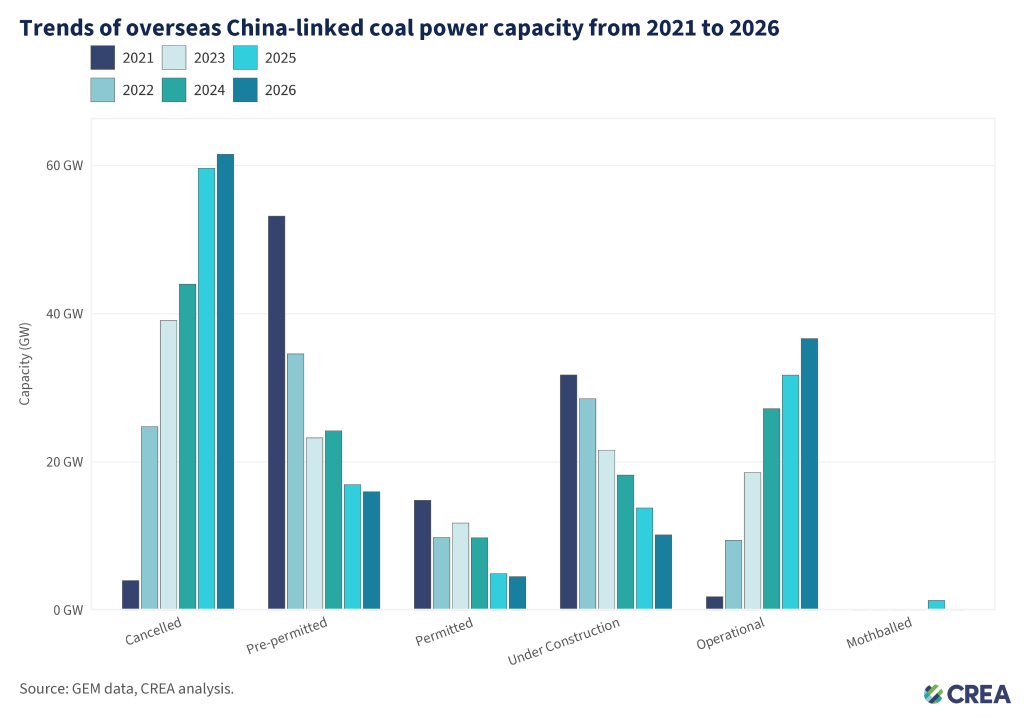
Figure — Trend of overseas China-linked coal power capacity from 2021 to 2026
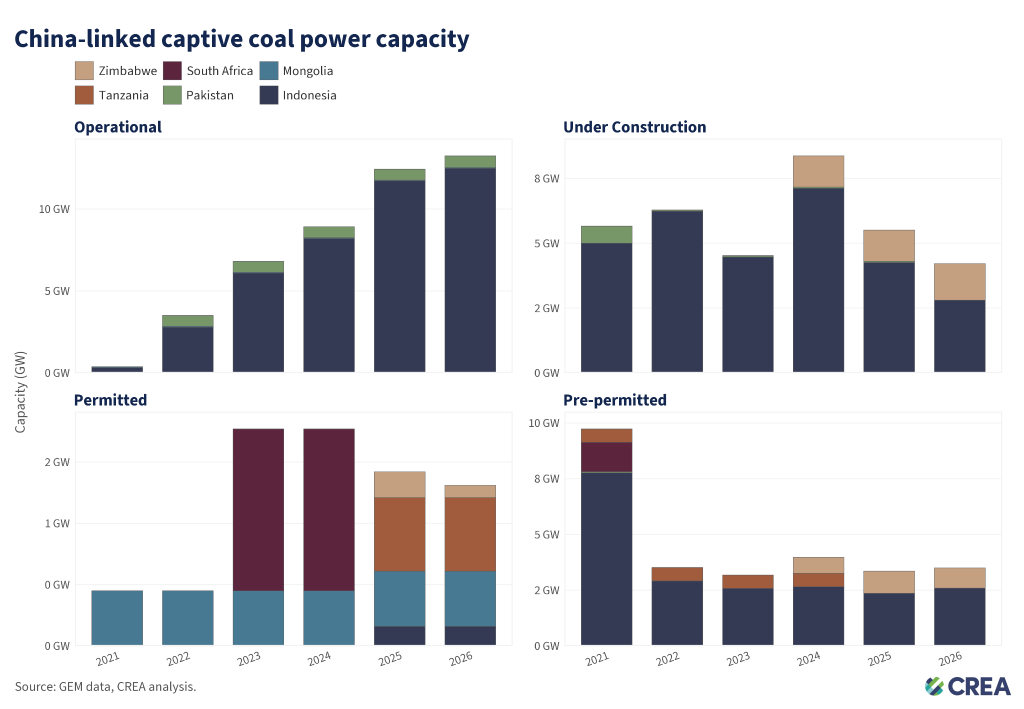
Figure — Trend of overseas China-linked captive coal power capacity from 2021 to 2026
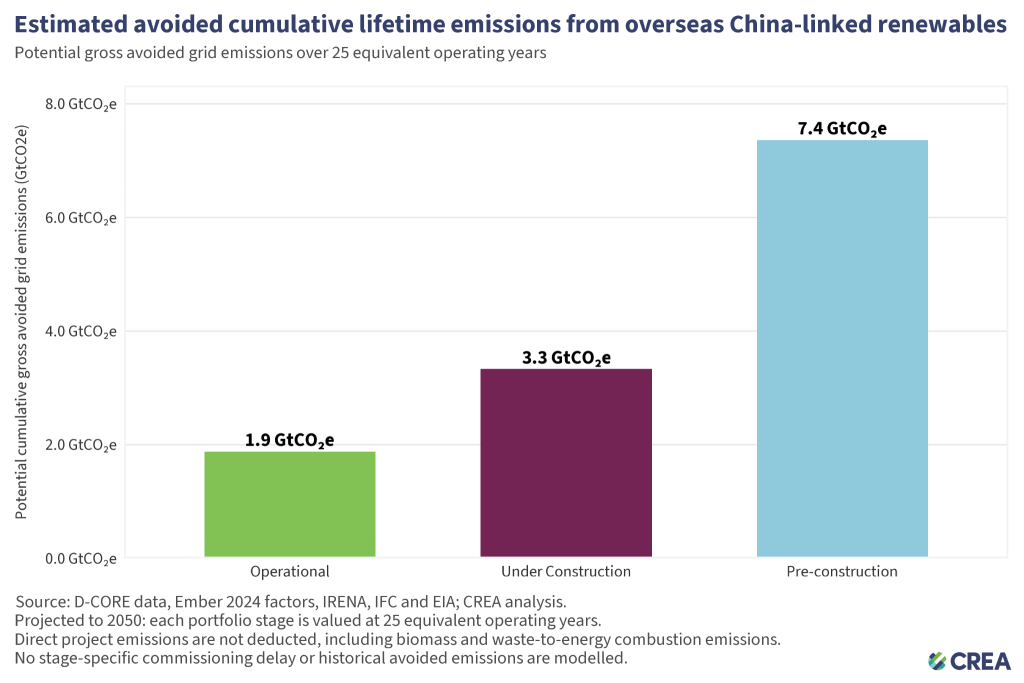
Figure — Estimated avoided cumulative lifetime emissions from overseas China-linked renewables
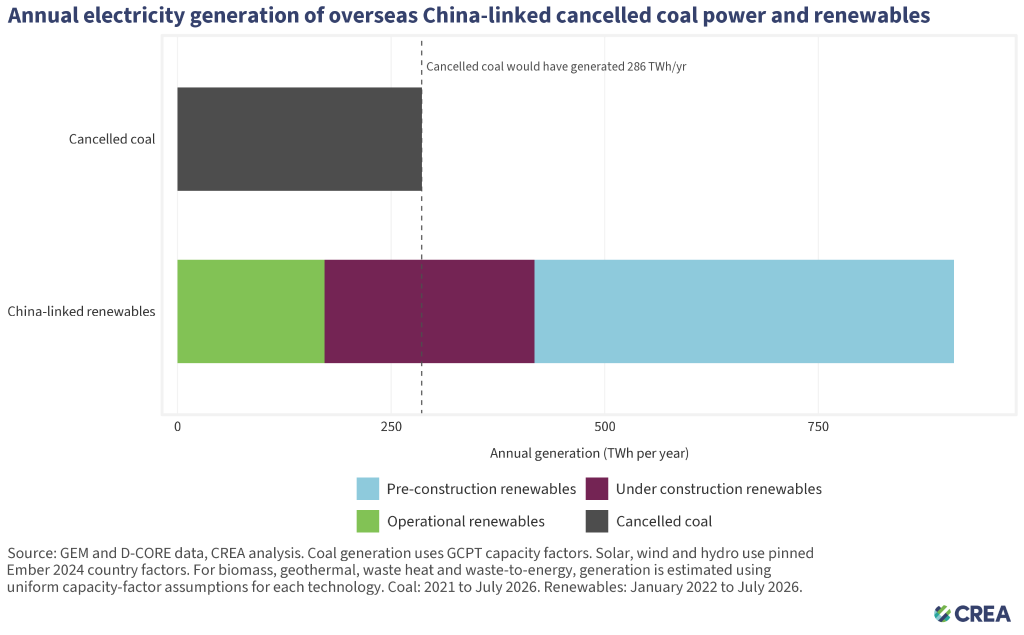
Figure — Annual electricity generation of overseas China-linked cancelled coal compared to renewables
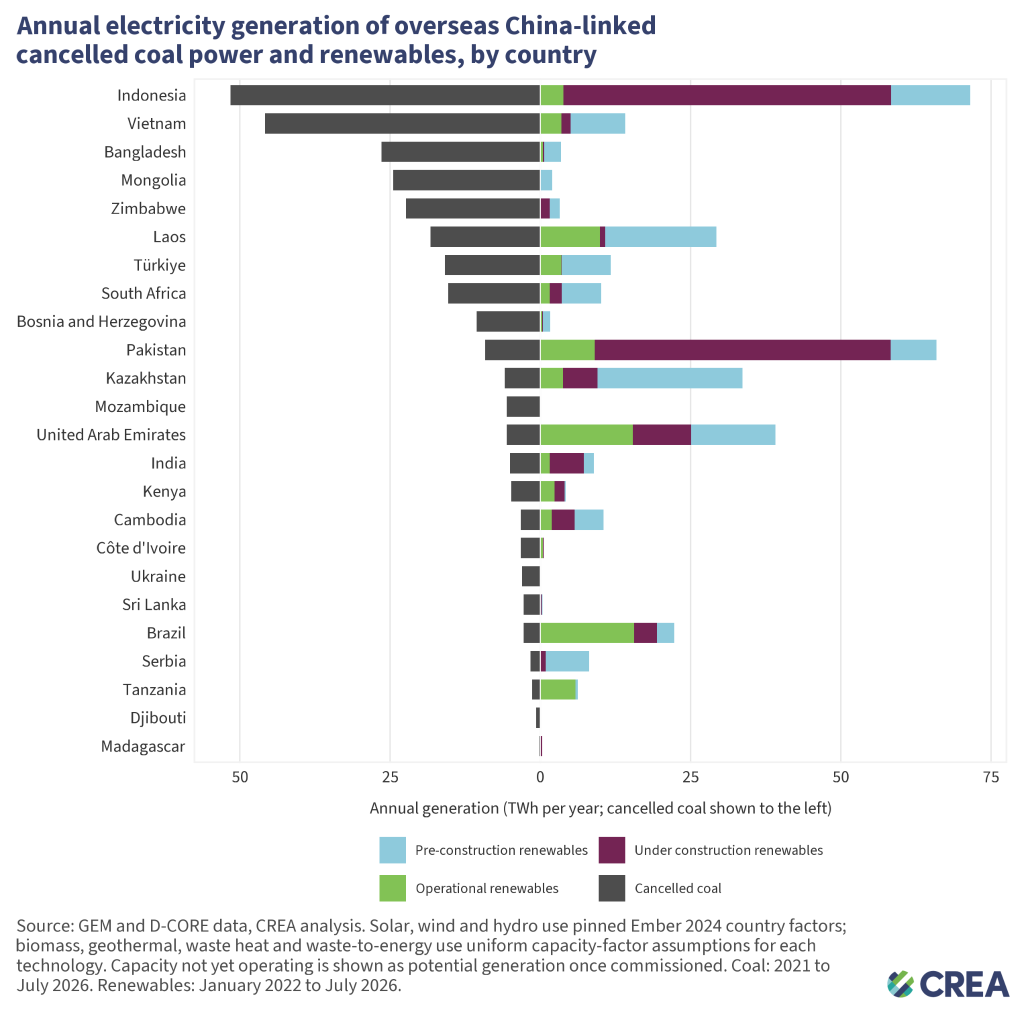
Figure — Annual generation of overseas China-linked cancelled coal power and renewables
Recommendations
If the 20.5 GW of currently planned coal power projects go ahead, they represent a growing reputational risk to China, especially as it seeks to take on a leadership role in global climate governance. To demonstrate its position as a responsible power and major contributor to global climate action, China should work with partner countries to:
- Maximise the opportunities presented by renewable energy: replacing coal with renewables will support climate goals, electrification, energy security, and the global transition.
- Immediately cancel or repurpose all coal projects overseas that have not yet started construction while developing retirement and renewables replacement pathways for operational projects.
- Address the captive coal power loophole by implementing the pledge on captive coal projects, alongside integrating renewables into existing overseas industrial parks, and developing new zero-carbon industrial parks.
- Strengthen governance of the pledge by designating a specific governance body that will oversee compliance with the pledge alongside strengthening transparency and accountability.