
By Lauri Myllyvirta
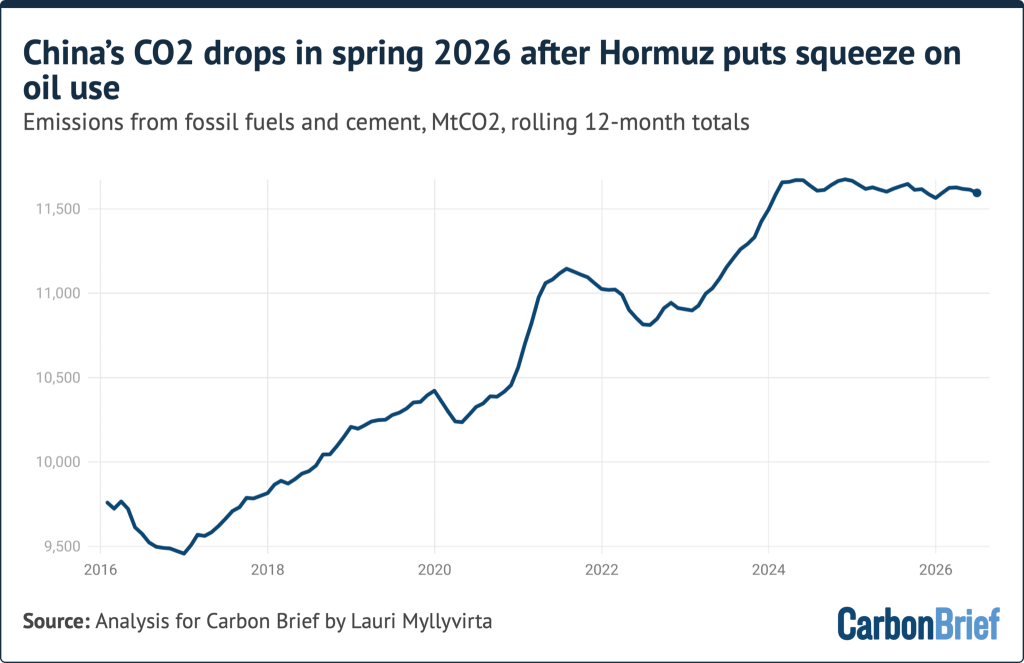
China’s carbon dioxide (CO2) emissions fell by 1% in the second quarter of 2026, as oil consumption plummeted amid the strait of Hormuz crisis.
The country’s use of oil fell by 9% overall and by 16% for transport, after the disruptions to supply from the Gulf through the strait.
China’s total CO2 emissions fell despite a continued rebound in coal-fired power generation.
This is the first time that reductions in oil consumption have been responsible for a fall in CO2 emissions overall – in all previous cases, coal consumption has been the main driver.
Other key findings for the second quarter of 2026 include:
- Electric vehicles (EVs) and public transport have become key factors in China’s oil demand, enabling transportation levels to increase even as fuel use fell sharply.
- The effect of EVs on oil consumption was almost twice as large as would be expected based on the increase in the number of EVs on the road alone, as the usage of existing EVs surged.
- Oil consumption displaced by EVs in China in the first half of 2026 exceeded the UK’s total oil consumption over a six-month period.
- These structural factors are not sufficient to account for the size of the fall in oil consumption, leaving behaviour changes as the other explanation.
- “Curtailment” of solar and wind output caused coal power to rise, despite strong hydro output, solar and wind capacity growth, as well as slower demand growth.
- Major increases in coal-power capacity and a power market that continues to favour coal limited the amount of coal generation displaced by new wind and solar capacity.
- Defying expectations of a boom, annual growth in coal use for chemicals production slowed down to 8%, from 15% in 2025 and 19% in the first quarter.
The second quarter of 2026 was a busy time for China’s government planners, with numerous energy-related five-year plan documents being released.
These plans list new measures to address solar and wind curtailment, as well as signalling a higher bar for the approval of new coal-power plants, but add few new quantitative targets.
After a 2% increase in the first quarter of 2026 and a 1% decline in the second, emissions are up marginally across the first half of the year, but they remain below their peak in 2023-24.
In addition, China is on track to add enough wind, solar, nuclear and hydropower this year to cover electricity demand growth, despite a slowdown in new capacity.
Given the structural pressures on oil demand, continued declines in real-estate construction and slower growth for coal-chemicals, China’s emissions could still fall this year. The emission trend remains a race between energy demand growth and clean-energy growth, both of which have slowed down this year.
Read the full article here.