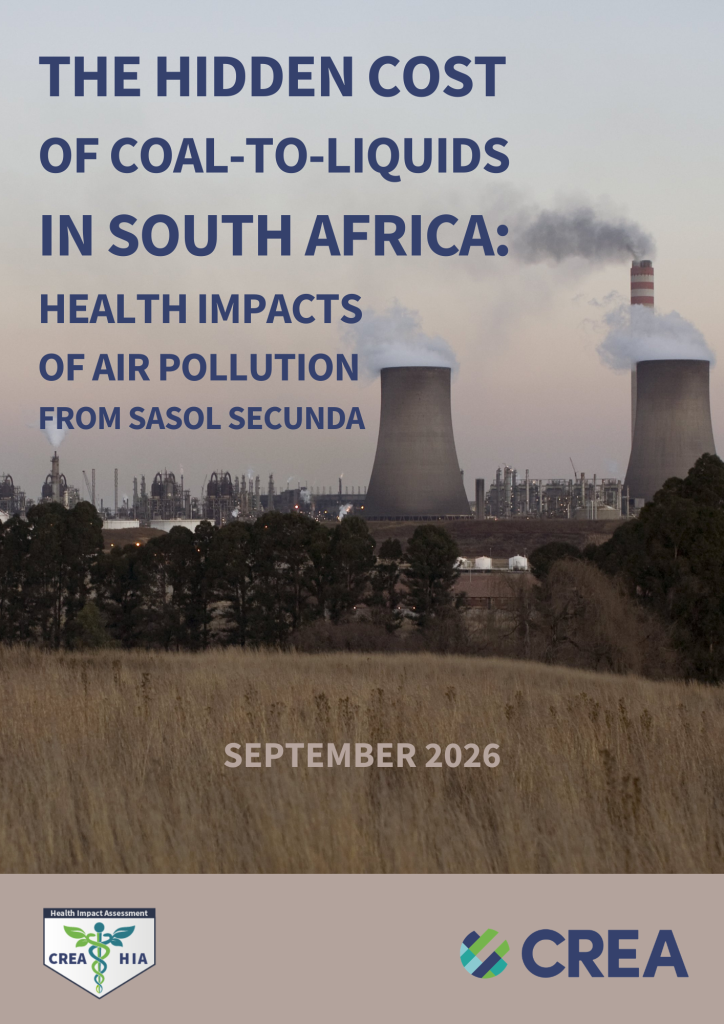
On International Day of Clean Air for Blue Skies 2026, CREA published its health impact assessment (HIA) looking at the economic and health impacts of the world’s largest point-source emitter of greenhouse gases: Sasol Secunda coal-to-liquids facility, located in the Highveld Priority Area (HPA) of South Africa — designated as such due to significant air pollution requiring specific air quality management action.
For the past 50 years, Sasol Secunda Operations has made its home in the Highveld, where its industrial emissions responsible for a rotten egg smell are a feature of daily life for local residents and on occasion travel as far as Johannesburg and Pretoria — 150 km away — due to the transboundary nature of air pollution.
In 2024 alone, it emitted an estimated 112 kilotonnes of sulphur dioxide (SO₂), along with significant amounts of hydrogen sulphide (H₂S).
The report estimates that some 1,000 deaths are attributable to particulate matter (PM2.5) and nitrogen dioxide (NO2 ), specifically, from the facility’s operation. The deaths are estimated to correspond to 23,800 years of life lost, cumulatively, across the exposed population.
In addition to deaths, the health impacts of air pollution cause long-term suffering and children are hit the hardest, with a knock-on effect on future generations. CREA’s analysis shows that, in 2024, emissions from Sasol Secunda Operations contributed to an estimated 1,100 preterm births, as well as increased risks of low birthweight, further adverse birth outcomes, and later, an increase in the burden of childhood asthma.
Although Sasol is regarded as one of South Africa’s industrial powerhouses and providers of employment, the health impacts of Sasol Secunda operations are estimated to cost the South African economy approximately USD 1.0 billion (ZAR 19 bn) each year.
Policy recommendations
The Centre for Research on Energy and Clean Air (CREA) recommends that South Africa’s Minister of Forestry, Fisheries and the Environment:
- review Sasol Secunda’s alternative SO2 limits, taking into account their impacts on air quality, population exposure and health;
- require binding annual emissions reductions across the entire Sasol Secunda complex, covering SO2, NOX, particulate matter and H2S;
- strengthen emissions reporting and independent monitoring, with data made publicly available;
- strengthen South Africa’s air-quality regulations to better protect human health; and
- put affected communities at the centre of emissions enforcement and Highveld air-quality planning.