Sulfur dioxide (SO2), a toxic gaseous pollutant, is crucial to control at the source because once in the atmosphere it is converted into secondary pollutants, thereby contributing a significant portion to particulate matter. Fossil fuel burning in coal-fired power plants (CFPPs) and industries is a major source of anthropogenic SO2 emissions. Globally, India is the largest emitter of SO2 from the power sector, with 6.2 million tonnes.
The Ministry of Environment, Forest and Climate Change (MoEFCC) issued a notification in December 2015 requiring all CFPPs to comply with SO2 emission norms by installing FGD by 2017. However, due to repeated, widespread non-compliance, the government has extended the compliance timeline for coal-fired power plant units four times.
Last year’s notification in July 2025 marked a significant rollback. As there were no changes for Category A and it had to comply by 2027, Category B coal-fired power plants had to comply on a case-by-case basis, subject to an expert appraisal committee. But for Category C, all units (78% of Indian plants) were exempted, meaning no control technology is required.
This analysis proposes that to reduce the substantial amount of SO2 emitted and its contribution to particulate matter formation in India’s most polluted region, the mandatory installation of FGD must be extended to all coal-fired power plants in India to reduce pollution and human health impacts, regardless of category.
Key Findings
- Globally, India is the largest emitter of sulfur dioxide (SO2) from the power sector, releasing over 6 million tonnes annually.
- Emission norms first issued in 2015 mandated the installation of flue gas desulphurisation (FGD) systems on CFPPs to reduce SO2 emissions by 2017. Not only has the deadline been extended four times, but the latest notification issued in July 2025 exempted 78% of coal-fired power plants from installing FGD systems.
- CREA’s estimates of SO2 emissions from CFPPs within a 300-km radius of the Delhi National Capital Region (NCR) found that there are 12 coal-fired power plants with a total of 37 units — publicly available data on their stack emissions show that 20 units exceeded the SO2 emission standards, five complied, and the remaining 12 had no data available.
- Our assessment estimated that 154 kilotonnes of SO2 are emitted by 25 units with data. Of these, 90% of emissions come from CFPPs without FGD. Category “C” coal-fired power plants, which, by mandate, do not require FGD installation, accounted for 81% of estimated SO2 emissions.
- According to a recent peer-reviewed study, the energy sector contributed up to 16% of particulate matter pollution in the Delhi-NCR cities. The ongoing operation of CFPPs without any control technology contributes to the formation of secondary PM2.5, worsening local and transboundary pollution and posing health risks.
- CREA’s findings strongly recommend reinstating the mandatory installation of FGDs at all coal-fired power plants, regardless of their categorization. Real-time online continuous emission monitoring data must also be made available to the public to verify compliance.
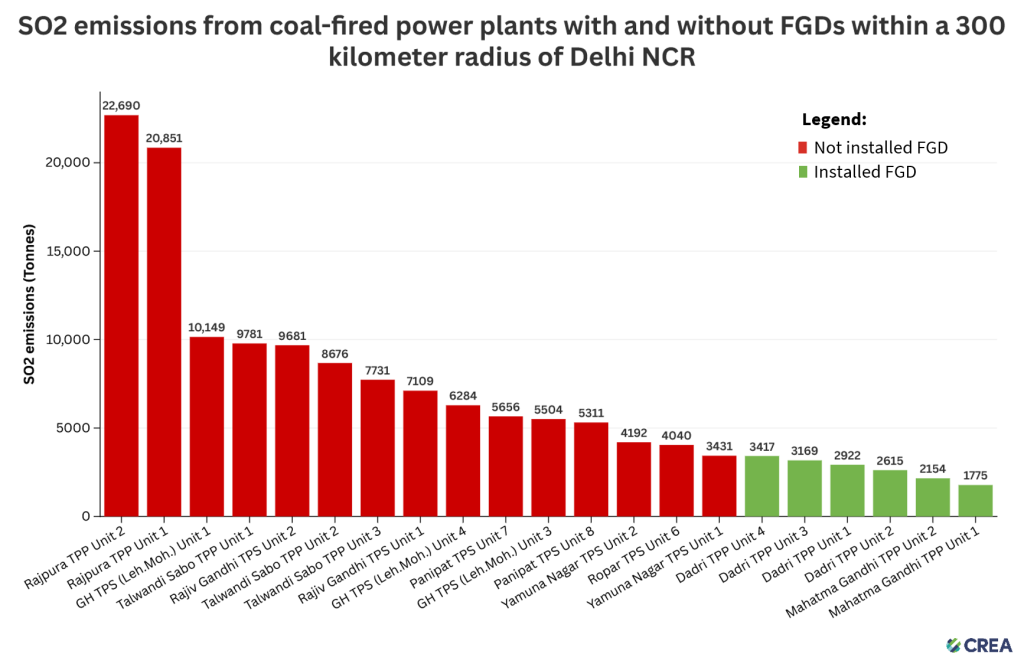
Figure — Comparing the SO2 emissions from coal-fired power plants with and without FGD located within a 300-kilometer radius of Delhi NCR