
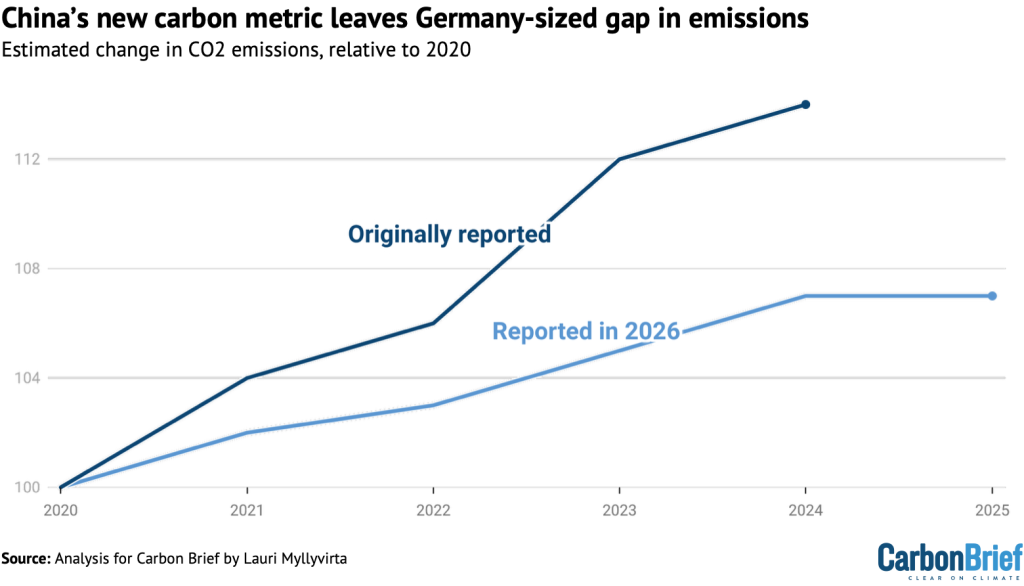
A major change in the way that China measures its core climate goal has effectively halved the growth in the country’s carbon dioxide (CO2) emissions over the past five years.
The revised measure of “carbon intensity”, the amount of CO2 per unit of economic output, implies that China’s emissions have only gone up by 7% from 2020-2025.
This is just half of the 14% rise indicated by previous official statistics.
On paper, the revision creates a gap of 700m tonnes of CO2 (MtCO2) per year, equivalent to the total emissions of Germany or South Korea.
While China has never officially defined how it measures carbon intensity, it has now made what appears to be a retrospective change, with the effect of making targets easier to meet.
The shift means that China officially came close to meeting its carbon-intensity target for 2020-2025, whereas official statistics had previously pointed towards falling well short.
The new definition of carbon intensity has not been made public, but plausible approaches to calculating the metric do not seem to be sufficient to explain the Germany-sized gap.
The apparent gaps or inconsistencies in China’s new carbon accounting also mean that China could meet its international climate pledges for 2030, even if its emissions go up, whereas the previous measure would have required them to fall.
This article explains how the metric appears to have shifted, what changes might potentially explain the revision and what the revised measure implies for China’s climate goals.
This analysis was written by Lauri Myllyvirta, lead analyst at CREA and senior fellow at Asia Society Policy Institute.
Read the full analysis here on Carbon Brief.