
FINANCING PUTIN’S WAR – GEORGIA
Three years after the EU’s ban on Russian oil products, Georgia’s Black Sea coast ports of Kulevi and Batumi have exported EUR 1.2 bn of refined fuels suspected of containing Russian oil to sanctioning jurisdictions
Introduction
The EU’s 18th sanctions package, agreed on in July 2025, announced a ban on the importation of oil products (HS trade code 2710) made from Russian crude oil (HS 2709). However, this ban does not address the issue of refined Russian oil products entering ports in non-sanctioning countries and being blended, processed, or re-exported to the EU and other sanctioning jurisdictions.
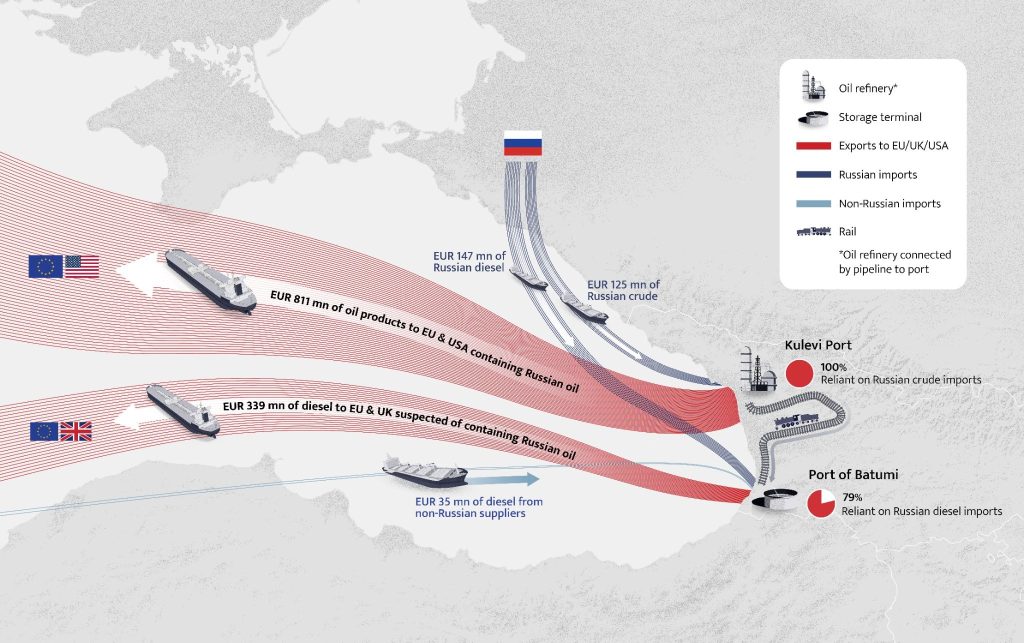
Georgia appears to have taken advantage of a lack of enforcement and loopholes in the sanctions in two ways. The Kulevi refinery — a newly commissioned oil refinery near Georgia’s Kulevi oil terminal and port, and connected to them via pipeline — has exploited the refining loophole to import 100% of its crude oil feedstock from Russia and then export oil products to the EU and the USA via the port of Kulevi (hereafter referred to as Kulevi port). The Kulevi refinery appears to have violated EU regulation Article 3ma of Council Regulation (EU) No 833/2014, which prohibits the importation by EU countries of oil products derived from Russian crude after 21 January 2026. Simultaneously, Georgia’s Batumi oil terminal and port (hereafter referred to as the port of Batumi) appears to be blending and relabelling Russian oil products before reselling them to sanctioning countries, thereby violating EU and UK sanctions.
The two ports (Kulevi and Batumi), located on the Black Sea coast, are connected to Georgia’s national railway network, which makes tracking Russian oil molecules contained in their exports to sanctioning jurisdictions especially difficult. The land connections and routes exploit challenges in tracing oil flows and circumventing enforcement paradigms.
Both ports appear to be importing significant quantities of Russian oil and exporting cargoes that violate both the EU and the UK sanctions.
Key findings
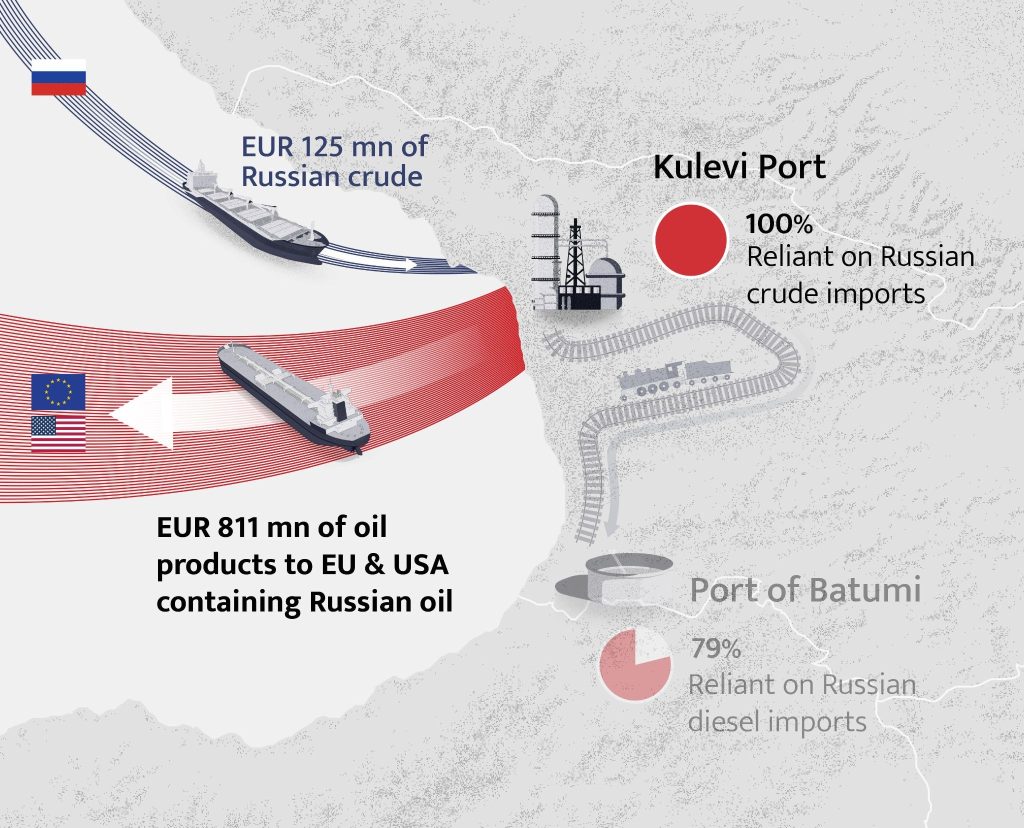
Figure 1 — The Kulevi port
Kulevi
The Kulevi refinery is located on Georgia’s Black Sea coast near the Kulevi port, and is connected to the port via pipeline. The refinery has reportedly relied solely on Russian crude since opening in October 2025.
- The Kulevi refinery received its first shipment of 105,340 tonnes of Siberian Light grade crude oil from the Russian oil company RussNeft on 6 October, 2025. The vessel Kayseri (IMO 9292199), which transported this shipment from the Russian Black Sea Port of Novorossiysk, was sanctioned by the EU less than three weeks after it completed its journey.
- Between 6 October 2025 and the end of May 2026, six shipments of Russian crude oil had been unloaded at the Kulevi port — the port had not documented receiving crude shipments from any other nation.
- The Kulevi port has exported 1.46 mn tonnes of oil products — a significant proportion likely produced at the nearby Kulevi refinery — to the EU and the US, worth EUR 811 mn, in the three-year period following the EU’s ban on Russian refined oil products.
- On 26 January 2026, five days after the implementation of the EU’s ban on oil products made from Russian crude, the Kulevi port exported almost 6,000 tonnes of PyGas (a by-product of fossil fuel processing with high potential for gasoline blending) to the Spanish port of Barcelona. A second shipment suspected of violating the EU’s sanctions on oil products made from Russian crude consisted of 2,715 tonnes of ultra-low sulphur diesel (ULSD), departing on 14 March 2026 and arriving at the Bulgarian port of BMF Burgas on 17 March 2026.
- On 30 March, after being included in the initial draft of the 20th EU sanctions package, the CEO of Kulevi refinery’s operating company announced the intention to transition to Turkmen and Kazakh oil; however, no timeline for the transition has been announced. Furthermore, another shipment of Russian crude was unloaded at the Kulevi port on 14 May, after the CEO announced its plan to “completely replace existing Russian crude”.
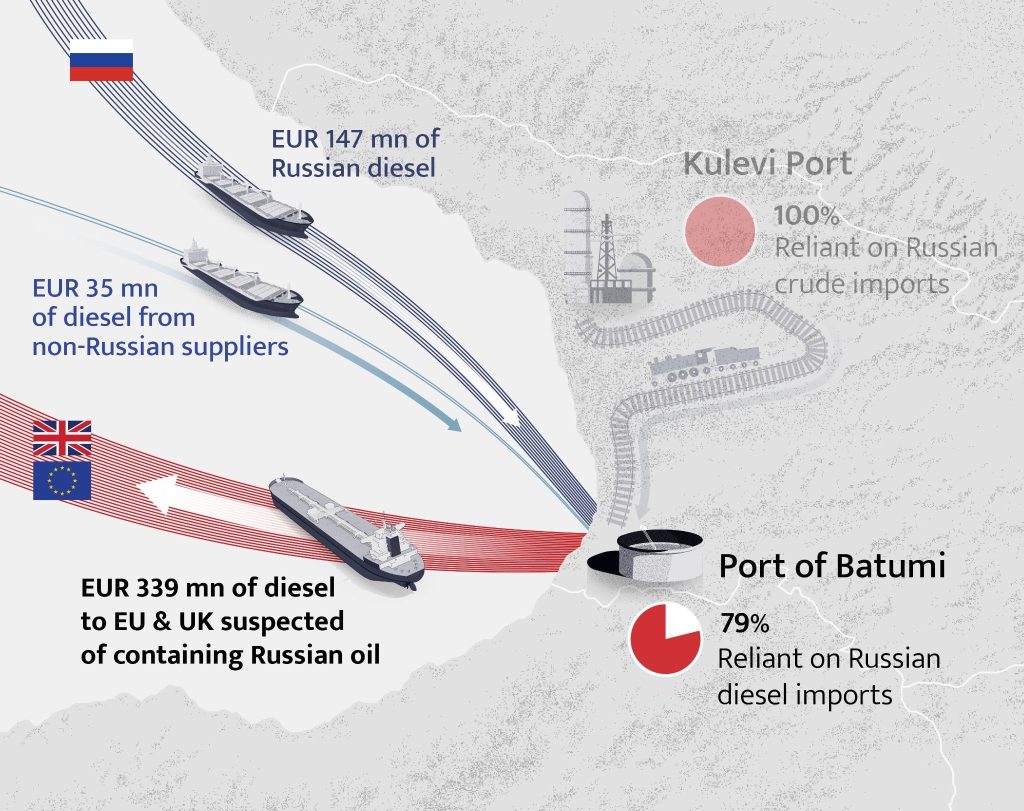
Figure 2 — The port of Batumi
Batumi
Meanwhile, less than 100 kilometres along the Black Sea coast sits the port of Batumi and oil terminal.
- In the first three years of the EU’s ban on Russian oil products (5 February 2023 to 5 February 2026), the port of Batumi has received 79% of its seaborne diesel imports from Russia, 204,000 tonnes valued at EUR 147 mn. Its seaborne imports of non-Russian diesel totalled 53,000 tonnes in this period.
- In the same period, diesel exports from the port of Batumi to the EU and UK totalled 508,000 tonnes, valued at EUR 339 mn.
- In the three-year period after the EU’s ban on Russian oil products, the port of Batumi exported more than nine times the volume of diesel to the UK and EU than it received via non-Russian seaborne imports, raising questions about the exported fuel’s true origin.
- In the three-year period after the EU’s ban on imports of Russian oil products, 90% of the port of Batumi’s diesel exports have been to the EU and UK.
- The UK is the largest importer of diesel from the port of Batumi, receiving 44% of the sanctioning jurisdictions’ imports since the EU ban. The Netherlands, the second largest importer, received 20% of the port of Batumi’s diesel exports that ended up in sanctioning countries. Denmark (19%), Sweden (8%), Belgium (5%), and Italy (2%) round off the top six importers from the port of Batumi.
- Existing pipeline and rail infrastructure provides the potential to transport petroleum products from the Kulevi refinery to the port of Batumi. To add to the complexity, the Kulevi port received 23,000 tonnes (EUR 15 mn) of seaborne diesel from Russia in the three-year period following the EU’s ban on Russian oil products, the final destination of which is unknown.
- Batumi Oil Terminal has a history of regulatory and legal issues, including allegations that it smuggled more than 10,000 tonnes of undeclared crude oil through customs evasion schemes.
Policy recommendations
CREA’s proposed measures aim to prevent sanctioning jurisdictions from importing oil products containing Russian molecules and to discourage refineries and re-export terminals from relying on Russian hydrocarbons if they want access to Western markets.
- The UK, EU, and US must ban imports of oil products or petrochemicals from ports that have received a shipment of Russian crude or refined fuels in the prior six months to dispel concerns of re-exportation, blending, illegal relabelling, or further processing of Russian hydrocarbons that finance the Kremlin’s war chest.
- Sanctions must also ban the importation of oil products or petrochemicals from ports with a feasible connection to a pipeline or railway that connects to a refinery that runs on Russian oil.
- Sanctions lists should be aligned across the EU, UK, and US. This needs to start with the EU and US sanctioning RussNeft — a Russian oil company that sold multiple shipments of Russian crude to the Kulevi refinery.
- Sanctions must be extended to include both the privately owned RussNeft and other entities connected to state-owned Russian oil producers, such as Rosneft. RussNeft has exploited a loophole that allows it to continue operating with entities in sanctioning jurisdictions, as it is the company’s founder, Mikhail Gutseriev, rather than the company itself, that is under EU sanctions.
- The European Anti-Fraud Office and investigative body OLAF must conduct an investigation into the port of Batumi and the associated companies to gather evidence confirming whether the port is illegally re-exporting Russian oil products to the bloc and violating sanctions. If sufficient evidence of sanctions violations is obtained, significant fines and severe legal repercussions should be imposed to deter other operators from engaging in this illegal trade.
Methodology
CREA uses data from Kpler and government sources for refinery data to estimate the value and volume of oil products made from Russian crude for export to G7+ countries from third countries.
We assume that all feedstock crude oil is perfectly mixed by refineries to produce refined oil products. For each refinery, we multiply the percentage of the feedstock crude oil that is Russian-origin by the total volume of oil products flowing out of the refinery. This allows us to attribute products as being derived from Russian crude. For example, if 30% of a refinery’s feedstock crude is of Russian origin, and the refinery exports 100 tonnes of diesel, we assume that 30 tonnes of the diesel comes from Russian origin crude.
We use Kpler data to estimate the refineries’ imports of Russian crude oil and apply CREA’s pricing model to Russian crude.
CREA’s full data methodology is available here.
| This fact sheet draws from CREA’s work tracking the Russian fossil fuel flows that are financing Putin’s war on Ukraine. Find more relevant data and reports here. The Centre for Research on Energy and Clean Air (CREA) is an independent research organisation focused on revealing the trends, causes, and health impacts, as well as the solutions to air pollution. CREA uses scientific data, research, and evidence to support the efforts of governments, companies, and campaigning organisations worldwide in their efforts to move towards clean energy and clean air. CREA is politically independent. The designations employed and the presentation of the material on maps contained in this report do not imply the expression of any opinion whatsoever concerning the legal status of any country, territory, city or area or of its authorities, or concerning the delimitation of its frontiers or boundaries. Find more information here: energyandcleanair.org. |