In 2025, the South African Department for Mineral Resources and Energy (DMRE) released a new Integrated Resources Plan that continues and formalises plans to extend the operating lifetimes of ten Eskom-operated coal-fired power plants, with some plants running for at least an additional decade.
This shift delays coal phase-out and is in direct opposition to South Africa’s climate commitments. The country’s updated Nationally Determined Contributions (NDCs) commit to limiting greenhouse gas emissions to 350–420 MtCO₂e by 2030, while the Climate Change Act establishes a legal framework for a just transition to a low-carbon, climate-resilient economy. Extending coal makes these targets harder to achieve and locks in higher emissions from one of the country’s largest sources. As the power sector is typically one of the most straightforward to decarbonise, this failure places additional pressure on harder-to-decarbonise sectors to compensate.
The consequences go beyond carbon. Across Africa, climate change is already intensifying. Increasing heat, drought, floods, food insecurity, water stress, and health risks are placing growing pressure on livelihoods and public systems.
The latest health impact assessment (HIA) from CREA, Greenpeace Africa and GroundWork published on Earth Day 2026, quantifies the air quality impacts of the South African government’s plan to delay the phase-out of coal-fired power plants and reveals that delaying the phase-out of coal-fired power in South Africa will result in devastating health and economic consequences.
Keeping plants open beyond their planned retirement dates will cause an estimated 32,000 additional premature deaths between 2026 and 2050. The health burden extends heavily to children. The delay will result in 41,000 additional preterm births and 17,000 new cases of childhood asthma.
The economic toll of these health impacts is staggering. The cost to the South African economy comes to an estimated ZAR 721 billion (USD 38 billion). This includes lost working days and overwhelming pressure on the public healthcare system.
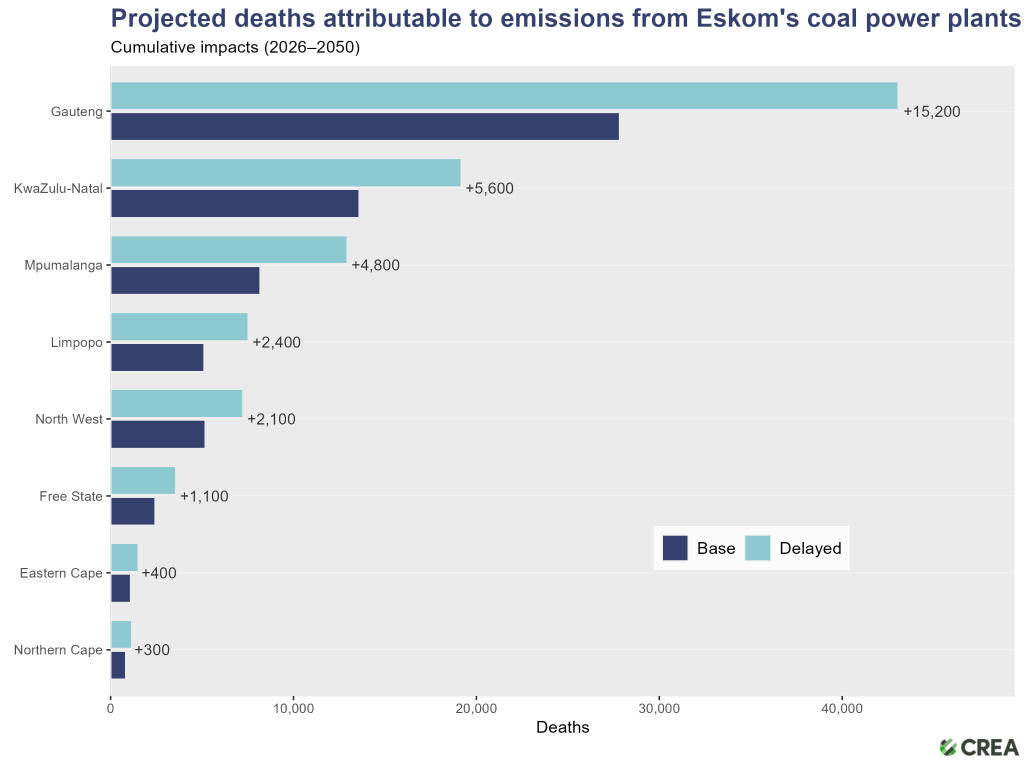
The majority of the coal power capacity in South Africa is located in Mpumalanga (almost 31.3 GW), followed by Limpopo (8.8 GW), and Free State (3.7 GW). In these provinces, the extension of coal power in the government’s new IRP is projected to have a dramatic impact on public health, leading to an estimated additional 4,800 deaths in Mpumalanga, 2,400 in Limpopo, and 1,100 in Free State.
These results highlight that, for local communities in coal-reliant regions, delayed coal phase-out may lead to a substantial increase in the public health burden. Previous research has identified coal combustion as a major contributor to harmful air pollution and associated health impacts in South Africa’s priority pollution hotspots.
Yet the report also highlights a critical geographic disparity. Gauteng is projected to absorb the largest share of additional deaths, with over 15,000 fatalities.
The province of Gauteng has no large Eskom coal-fired power stations. The transboundary pollution originates in Mpumalanga and migrates to Gauteng, notably Pretoria and Johannesburg, as seen in air quality modelling. KwaZulu-Natal will also be highly impacted, with 5,600 deaths expected. The reason for this is that coal-related PM2.5 can persist for one to two weeks and be transported over long distances by regional wind patterns, allowing it to cross provincial borders and affect large populations far from the pollution source due to the transboundary nature of pollution. High levels of PM2.5 persist in Johannesburg, even though the power plant is over 300 kilometres away.
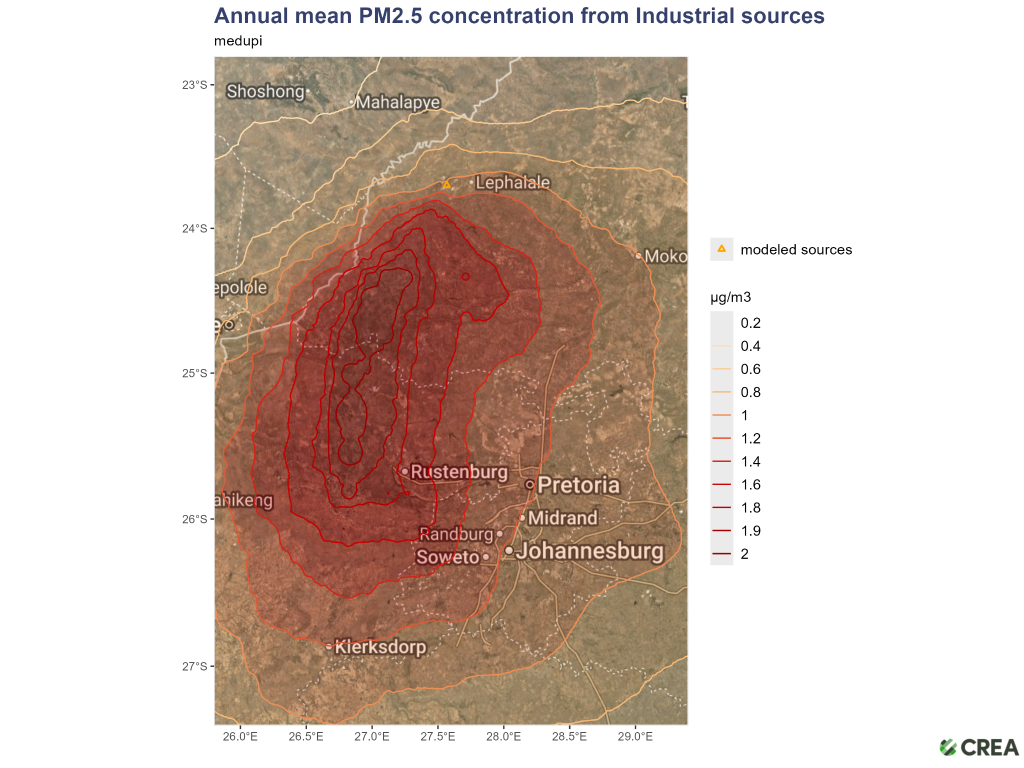
Note: This was simulated using the CALPUFF dispersion model.
Key findings
- Delaying the phase-out is projected to result in 32,000 additional premature deaths between 2026 and 2050.
- Gauteng is the most affected region, with an estimated 15,200 additional deaths, almost half of the total, despite having no Eskom coal-fired power plants.
- Mpumalanga, which hosts most coal capacity (31.3 GW), is projected to see an additional 4,800 deaths, showing the transboundary nature of pollution and that harm falls both where coal is burned and where pollution travels.
- Children bear a disproportionate burden: delayed phase-out would lead to an estimated 41,000 additional preterm births, 17,000 new childhood asthma cases, and 370 deaths in children under five.
- The estimated economic cost of these health impacts is approximately USD 38 billion (equivalent to ZAR 721 billion), placing a major burden on households, families, and communities, healthcare systems, and the wider economy.
- Delaying coal phase-out is a policy choice with severe public health and economic consequences, disproportionately affecting Gauteng and young children, while diverting resources from cleaner energy alternatives.