Tracking the effects of the latest fossil fuel crisis on global power generation
Global power generation from fossil fuels fell in the first month since the start of the Hormuz closure, with the fall in gas-fired generation offset by large increases in solar and wind power, rather than coal.
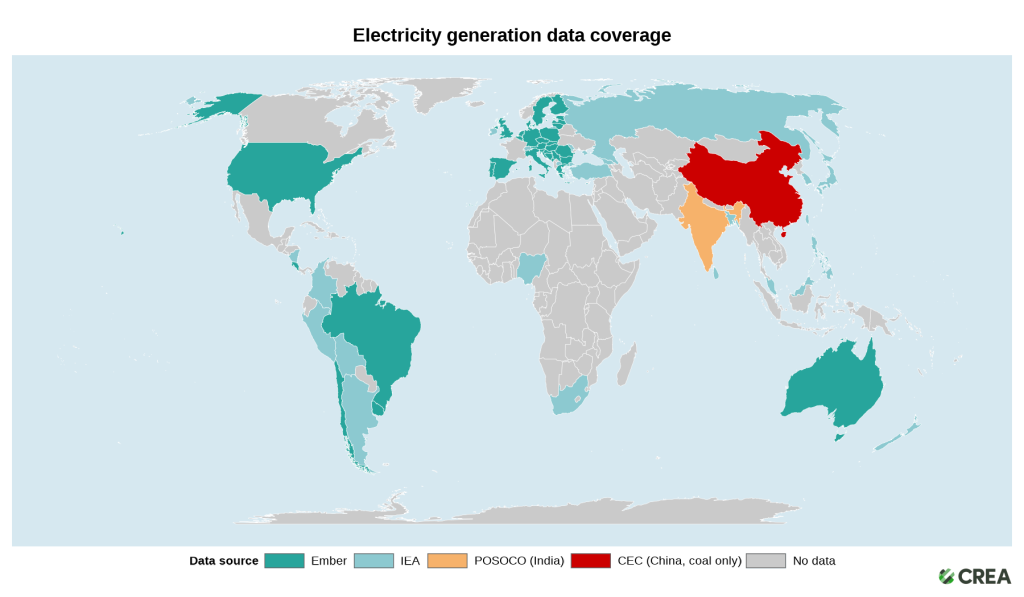
The power generation dataset prepared for this analysis covers countries that disclose near-real-time data. The dataset covers 87% of global coal power generation and over 60% of gas-fired power generation.
Total power generation from fossil fuels in countries with near-real-time data fell 1% year-on-year, with coal-fired generation flat and gas-fired generation falling 4%. The dataset covers the world’s largest power markets: China, the U.S., the EU, and India, among others.
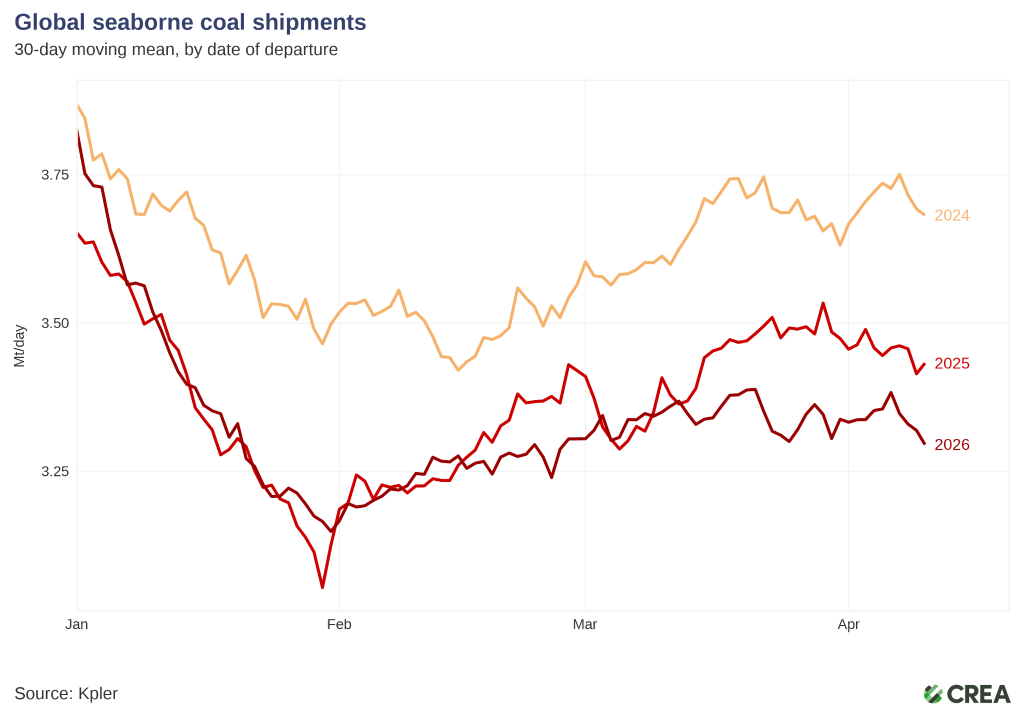
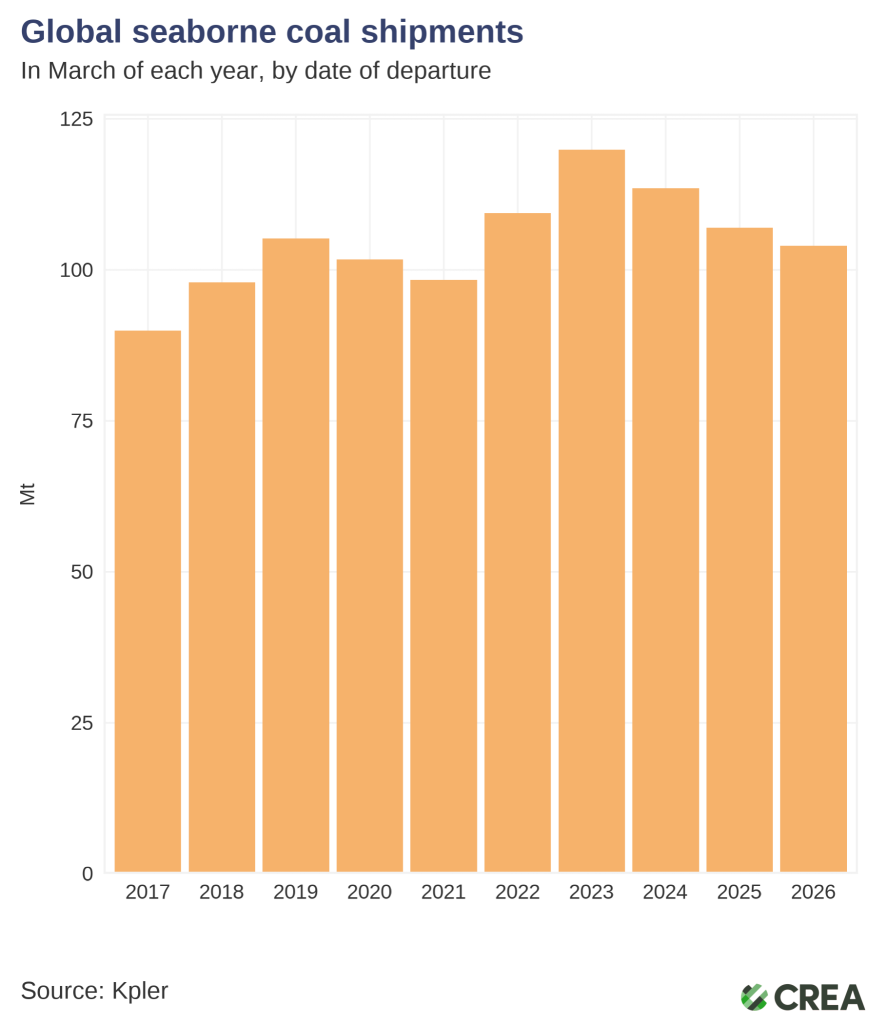
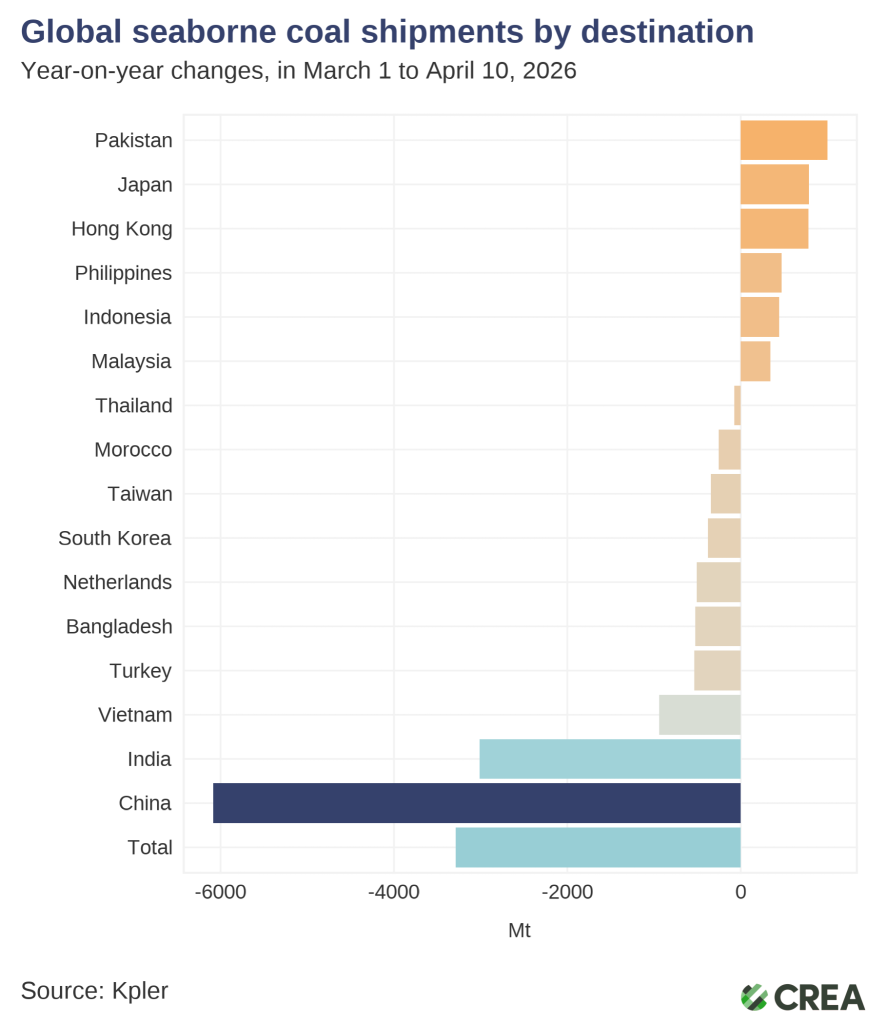
Seaborne coal transport volumes fell 3%, to the lowest levels since 2021. The data contradicts widespread expectations that coal power generation would rise in response to the crisis.
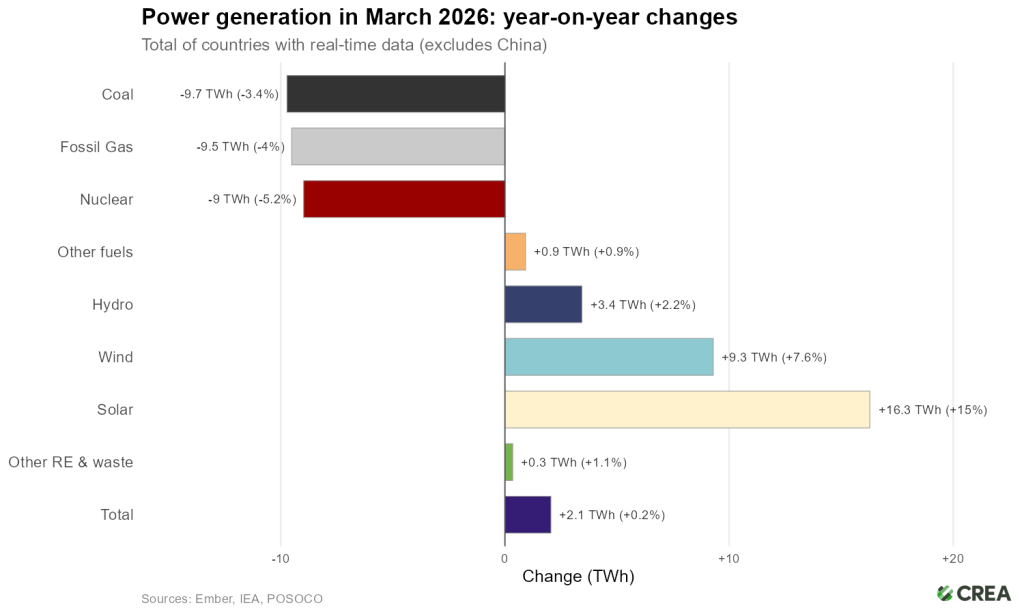
The record buildout of solar and wind in 2025 helped reduce the need for power generation from fossil fuels and mitigate the impact of the Hormuz closure.
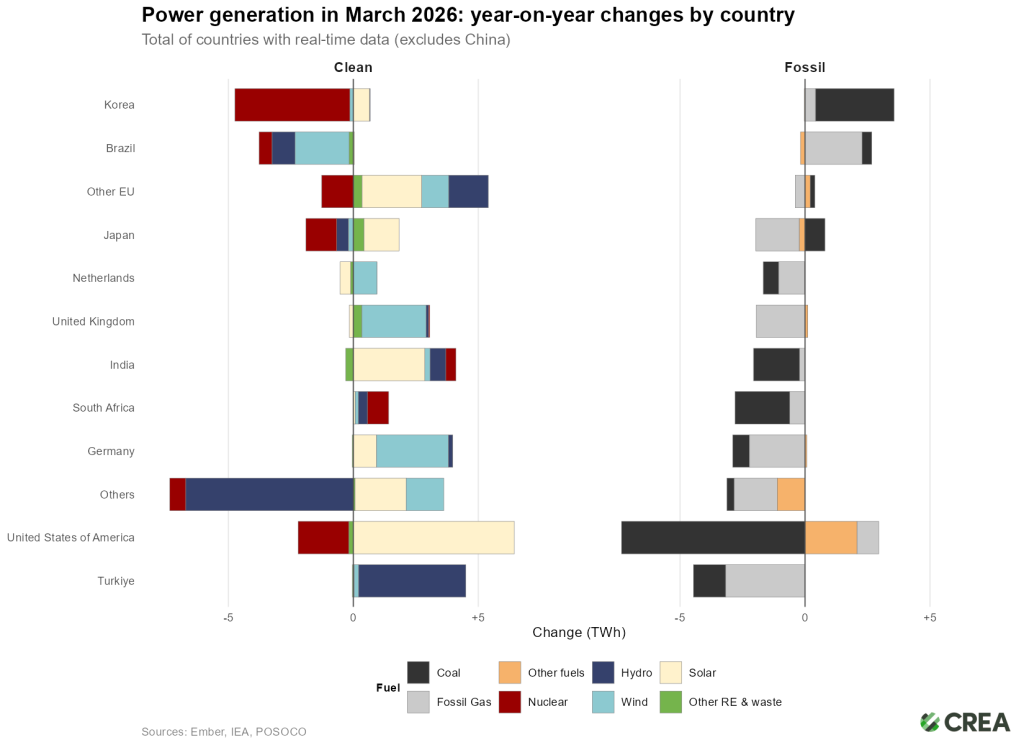
Outside China, in countries with real-time electricity data, coal-fired power generation fell 3.5% and gas-fired power generation fell 4.0% in March. This was due to increases in solar power (14%) and wind (8%) generation. Hydropower generation also saw a small increase (2%), but this was more than offset by a drop in nuclear power generation.
Coal-fired power generation fell in the U.S., India, EU, Turkey, and South Africa.
In China, power generation from coal increased 2% in March, according to weekly surveys by China Electricity Council, with generators on the coast shifting from gas to coal in response to the high prices. Coal-fired generation was still significantly below 2024 levels, however, as March 2025 recorded a steep 6% drop.
Total electricity generation growth in the countries with data turned from negative in January-February to positive in March, giving no indication that the Hormuz crisis affected power demand.
Highlighting the importance of rapid scale-up of clean energy for the global energy system, the solar and wind power capacity added in 2025 alone generates twice as much electricity as all the LNG that was transported through the Strait of Hormuz before the closure. 19% of the global LNG trade, some 112 billion m3, passed through the strait in 2025. When used for power generation, this gas would generate around 590 TWh of power, equal to France’s total power generation. In 2025, the world added around 510 GW solar and 160 GW wind, which will generate around 1100 TWh per year, based on average utilization factors calculated from Ember data.
Seaborne coal volumes have fallen since the closure
Seaborne coal transport volumes were also down 3% year on year in March according to Kpler, falling to the lowest levels since 2021, the height of the Covid pandemic. Departures of coal shipments to destinations in both China and India fell 9%, while those to South Korea fell 4%. Turkey and Vietnam saw drops of 25% and 27%, respectively. Japan, Indonesia, Malaysia, and the Philippines recorded increases, reflecting higher coal-fired power generation. These figures include within-country deliveries, which are significant e.g. in China and Indonesia.
‘Return to coal’ absent in data
After the Hormuz closure, a narrative of “a coal comeback” has taken hold among the media and some analysts, even though the data offer little support. The government statements used to create a “back to coal” narrative range from meaningless to inconsequential.
Similar to the current situation, there was a widespread belief that the world, and particularly Europe, would use more coal after Russia stopped gas exports to Europe. This seemed to be borne out for a few months, as weak nuclear and hydropower output led to increased power generation from fossil fuels — even if for reasons completely unrelated to the gas crisis. The actual, sustained result of the crisis was a sharp acceleration in clean energy and a record fall in Europe’s power sector coal use and CO2 emissions in 2023.
The key reason there has been no coal resurgence amid high gas prices is that coal already had lower operating costs than gas in all markets before the current crunch. Therefore, coal plants were already running at as high rates as they could, given the time profile of demand and near-zero marginal cost supply — gas was filling in only where coal plants cannot ramp up and down fast enough to follow residual load. There has been no increase in coal capacity so far: no coal units were returned to service or delayed from retirement in any country in March.
While the short-term headroom for increases in coal use is highly limited, the long-term outlook is even more negative. The current fossil fuel crunch has made coal more expensive in absolute terms and in comparison to clean energy and energy storage, further discouraging investment in coal-fired power.
Country-by-country analysis
The largest reductions in coal-fired power generation took place in the U.S., India, South Africa, Turkiye, Germany, and the Netherlands.
In the U.S. and India, growth in solar power was the single largest driver of the fall in fossil power generation; in South Africa and Turkiye, improved operation of nuclear and hydropower plants was the main driver. In the Netherlands and Germany, growth in wind power generation made the largest contribution.
The only countries to see a significant increase in coal-fired power generation were Japan and South Korea. In these countries, weak nuclear power output was the key reason, allowing coal to take up some of the space for inflexible generation, unrelated to the global energy crisis.
China has seen a swing from gas to coal in coastal provinces, with coal power plants taking on more of the flexible generation role that gas-fired plants normally fill. However, the scope for switching from gas to coal in China is limited by the small role of gas in the country’s electricity system — gas makes up just 3% of overall generation.
Examples of clean energy policy and investment progress during the crisis
The largest and most direct impact of the high fossil fuel prices will be accelerated sales of clean energy technologies such as solar, EVs, and heat pumps directly to consumers, bypassing slower-moving government and utility decision-making.
There is, however, no shortage of announcements of clean energy policies and investments from governments and utilities in response to the crisis. They have not gotten the same spotlight as statements on coal which have fed a non-factual narrative of a “coal comeback”. Here are some examples:
- The French government will prepare a plan to electrify key sectors of the economy to reduce reliance on imported fossil fuels, suggesting the measures could be funded from increased corporate tax revenue from fossil fuel companies.
- Egypt plans to add 2,500 megawatts (MW) of renewable energy capacity to its national electricity grid before the summer. Part of purchase agreements (PPAs) covering renewable energy capacity, in addition to a deal to develop standalone battery energy storage systems (BESS), with a combined capacity of 5,620 MW.
- India’s Ministry of New & Renewable Energy (MNRE) has issued Bidding Trajectory for issuance of RE power procurement bids of 50 GW per annum by ‘Renewable Energy Implementing Agencies’ (REIAs) from FY 2023-24 to FY 2027-28.
- The Indonesian government announced the formation of a ministerial task force to implement President Prabowo’s 100GW solar vision (first announced last year), with the first rollout of 13 GW of solar already awaited this year.
- Japan will expand offshore wind permits.
- South Korea’s President Lee Jae Myung called for the country to move very quickly toward renewable energy in response to the latest energy price crisis.
- Turkish gov pledged to invest $80 billion in RE by 2035 to reach its 120 GW target.
- PowerChina secured a $1.9 billion solar and storage project in Abu Dhabi, boosting UAE clean energy goals, grid stability, and renewable capacity growth.
- The UK outlined a plan to decarbonize future housing with heat pumps and solar.
- The Vietnamese government updated the country’s “Just Energy Transition Partnership” (JETP) implementation plan, signaling a sharper shift away from coal, phasing out coal-fired plants from new energy infrastructure after 2030. Renewable energy is projected to account for 47% of installed capacity by 2030.
About the data
CREA compiled near-real-time power generation data from POSOCO, Ember, and the IEA to build as complete a dataset as possible. Coal-fired power generation in China was taken from the China Electricity Council’s weekly surveys. While there are significant omissions as many countries do not report data in a timely way, the dataset covers 87% of global coal power generation and over 60% of gas-fired power generation.