🇧🇷 A versão em português está disponível abaixo
In the southernmost Brazilian state of Rio Grande do Sul sits the rural municipality of Candiota. Far from any urban pollution hotspots, Candiota is home to an interdependent coal power plant and mining complex that is contributing outsized impacts to the health and economy both locally and across borders in neighbouring countries due to pollution from the coal power. This, in a country that is otherwise performing well in the energy transition, with coal contributing to only some 1.6% of the electricity mix.
According to this new health impact assessment (HIA), published by CREA and Instituto Internacional ARAYARA, the interdependent power plant and mining complex in Candiota municipality that consists of the Candiota coal mine and the Candiota III coal-fired power plant, and the Seival Sul coal mine and the Pampa Sul coal-fired power plant, has contributed to approximately 430 deaths and health-related economic damages of BRL 5.1 billion from 2017 to 2025.
If operations in Candiota continue until 2040, this would lead to an additional estimated 870 deaths and BRL 6.6 billion in health-related economic damages, reaching an estimated cumulative total of 1,300 deaths and BRL 11.7 billion from 2017 to 2040.
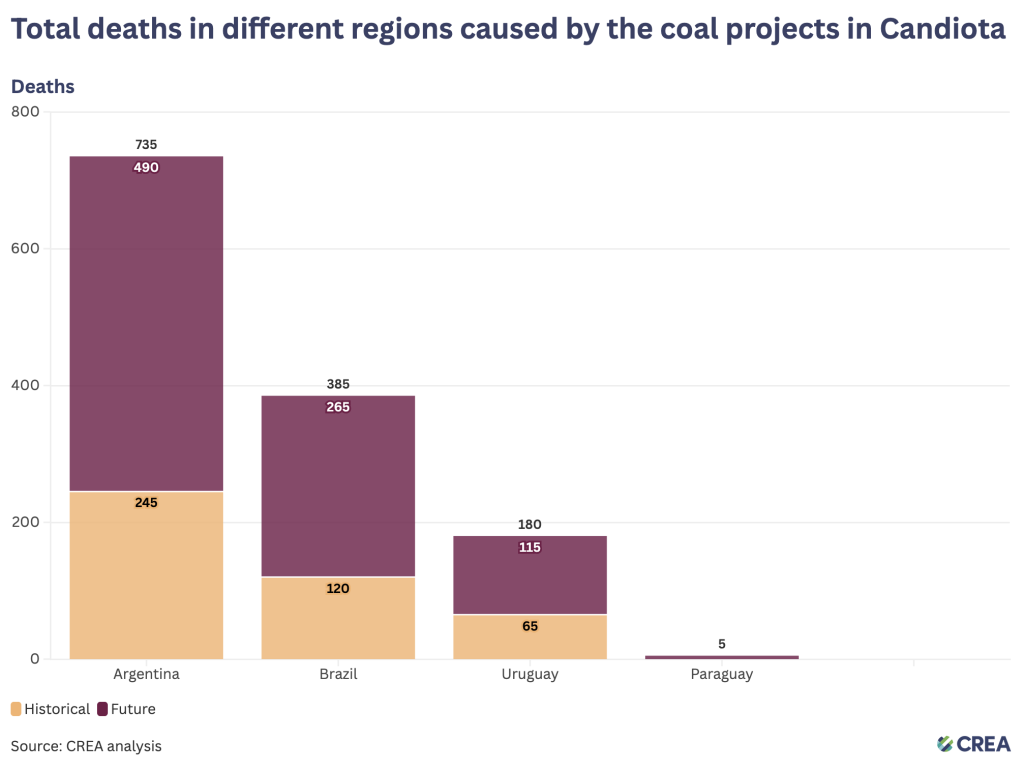
While Candiota’s coal operations are a local source of employment, the economic and health impacts of the operations on populations both in Brazil and neighbouring countries up until 2025 have been significant. Due to the transboundary nature of air pollution, the Argentinian population is the most impacted by the coal projects in Candiota, followed by Brazil, Uruguay, and Paraguay. The largest and most impacted cities are Buenos Aires, Rosario, and Santa Fe in Argentina, and Montevideo in Uruguay.
CREA and ARAYARA call on the federal government of Brazil to uphold Brazilian constitutional principles for the right to health, and immediately cease the contracting of coal-fired power plants until 2040 and beyond and adopt a legally binding timeline to retire the Candiota III and Pampa Sul coal-fired power plants, with no extensions beyond existing contracts. Governments elsewhere in the world have taken such steps at short notice at earlier stages in their energy transition. The Brazilian government must now take steps to invest in a just transition without delay.
Key findings
- Historical coal use in Candiota (2017–2025) has contributed to an estimated 430 (330–550) deaths and BRL 5.1 (3.5-6.3) billion in health-related economic damages.
- If this cluster continues to operate until 2040, this cluster will cause an additional estimated 870 (670–1,110) deaths and BRL 6.6 (5.3-8.9) billion in health-related economic damages, reaching an estimated cumulative total of 1,300 deaths and BRL 11.7 billion from 2017 to 2040, much of which would be avoidable through an earlier phase-out.
- The most affected populations are concentrated in cities in nearby countries, specifically Argentina, followed by Uruguay.
- The largest and most impacted cities are Buenos Aires, Rosario, and Santa Fe in Argentina, and Montevideo in Uruguay.
- The largest cities in Brazil, such as Rio de Janeiro and São Paulo, are geographically farther away from Candiota, leaving the population in Brazil less affected than Argentina.
- The Argentinian population is the most impacted by the coal projects in Candiota, followed by Brazil, Uruguay, and Paraguay.
- The largest and most impacted cities are Buenos Aires, Rosario, and Santa Fe in Argentina, and Montevideo in Uruguay.
- This health impact assessment (HIA) indicates that continued public support for coal mining and coal-fired power generation in Candiota leads to substantial, and largely avoidable, harm to public health, and that an earlier phase-out would significantly reduce associated health and economic damages.
Policy recommendations
- Accelerate phase-out of coal-fired power generation in Candiota, Brazil
- Termination of public subsidies and preferential financial treatment for coal operations
- Strengthened enforcement of environmental licensing and emission limits
- Integration of health evidence into judicial and regulatory decision-making
- Just transition policies for workers and local communities
| Methodology This health impact assessment (HIA) report evaluates the air pollution, health, and economic burden caused by the two largest coal mines and power plants operating in Candiota, Rio Grande do Sul, Brazil. The Candiota and Seival Sul coal mines, along with the Pampa Sul and Candiota III power plants, were selected for analysis due to their scale and interdependence. Nearly 100% of the coal extracted from the Seival Sul mine is used to generate electricity at the Pampa Sul power plant, while the Candiota mine supplies the Candiota III plant in a similar arrangement. Because the mines and plants are mutually dependent, reducing or retiring the operation of one would directly affect the operation of its corresponding facility. The report considers atmospheric emissions of sulfur dioxide (SO₂), nitrogen oxides (NOX), and fine particulate matter (PM2.5). From the coal plants, we retrieve their hourly flue gas concentrations from Continuous Emission Monitoring System (CEMS) data from 2021–2023, reported by Ambar Energia. These values are scaled to the study timeline from 2017 to 2040 by multiplying the yearly values by 30. For the coal mines, we estimate emissions by using emission factors from IPCC, EEA, and individual studies on these mines to obtain the most accurate emission factors with activity data, based on the mines’ production capacities. The full methodology is available in the report. |
| Metodologia Este relatório de Avaliação de Impacto à Saúde (AIS) avalia a poluição do ar e o ônus à saúde e à economia causados pelas duas maiores minas e usinas termelétricas a carvão que operam em Candiota, Rio Grande do Sul, Brasil. As minas de carvão de Candiota e Seival Sul, juntamente com as usinas termelétricas Pampa Sul e Candiota III, foram selecionadas para a análise devido a sua escala e interdependência. Quase 100% do carvão extraído da mina de Seival Sul é usado para gerar eletricidade na usina termelétrica Pampa Sul, enquanto a mina de Candiota fornece carvão para a usina Candiota III em um esquema similar. Como as minas e as usinas são mutuamente dependentes, reduzir ou descomissionar a operação de uma delas afetaria diretamente a operação da sua instalação correspondente. Neste estudo, consideramos as emissões atmosféricas de dióxido de enxofre (SO₂), óxidos de nitrogênio (NOX), e material particulado fino (PM2.5). A partir das usinas a carvão, recuperamos as concentrações horárias de gases de combustão a partir dos dados do Sistema de Monitoramento Contínuo de Emissões (SMCE) de 2021 a 2023, reportados pela Ambar Energia. Esses valores são dimensionados para o cronograma do estudo de 2017 a 2040, multiplicando os valores anuais por 30. Para as minas de carvão, estimamos as emissões usando fatores de emissão do IPCC, da AEA e de estudos individuais sobre essas minas para obter os fatores de emissão mais precisos com dados de atividade, com base nas capacidades de produção das minas. Consulte a seção Metodologia do relatório para obter a metodologia completa. |