
Coal power generation fell in both China and India in 2025, the first simultaneous drop in half a century, after each nation added record amounts of clean energy.
The new analysis for Carbon Brief shows that electricity generation from coal in India fell by 3.0% year-on-year (92 terawatt hours, TWh) and in China by 1.6% (46TWh).
The last time both countries registered a drop in coal power output was in 1973.
The fall in 2025 is a sign of things to come, as both countries added a record amount of new clean-power generation last year, which was more than sufficient to meet rising demand.
Both countries now have the preconditions in place for peaking coal-fired power, if China is able to sustain clean-energy growth and India meets its renewable energy targets.
These shifts have international implications, as the power sectors of these two countries drove 93% of the rise in global carbon dioxide (CO2) emissions from 2015-2024.
While many challenges remain, the decline in their coal-power output marks a historic moment, which could help lead to a peak in global emissions.
Double drop
The new analysis shows that power generation from coal fell by 1.6% in China and by 3.0% in India in 2025, as non-fossil energy sources grew quickly enough in both countries to cover electricity consumption growth. This is illustrated in the figure below.
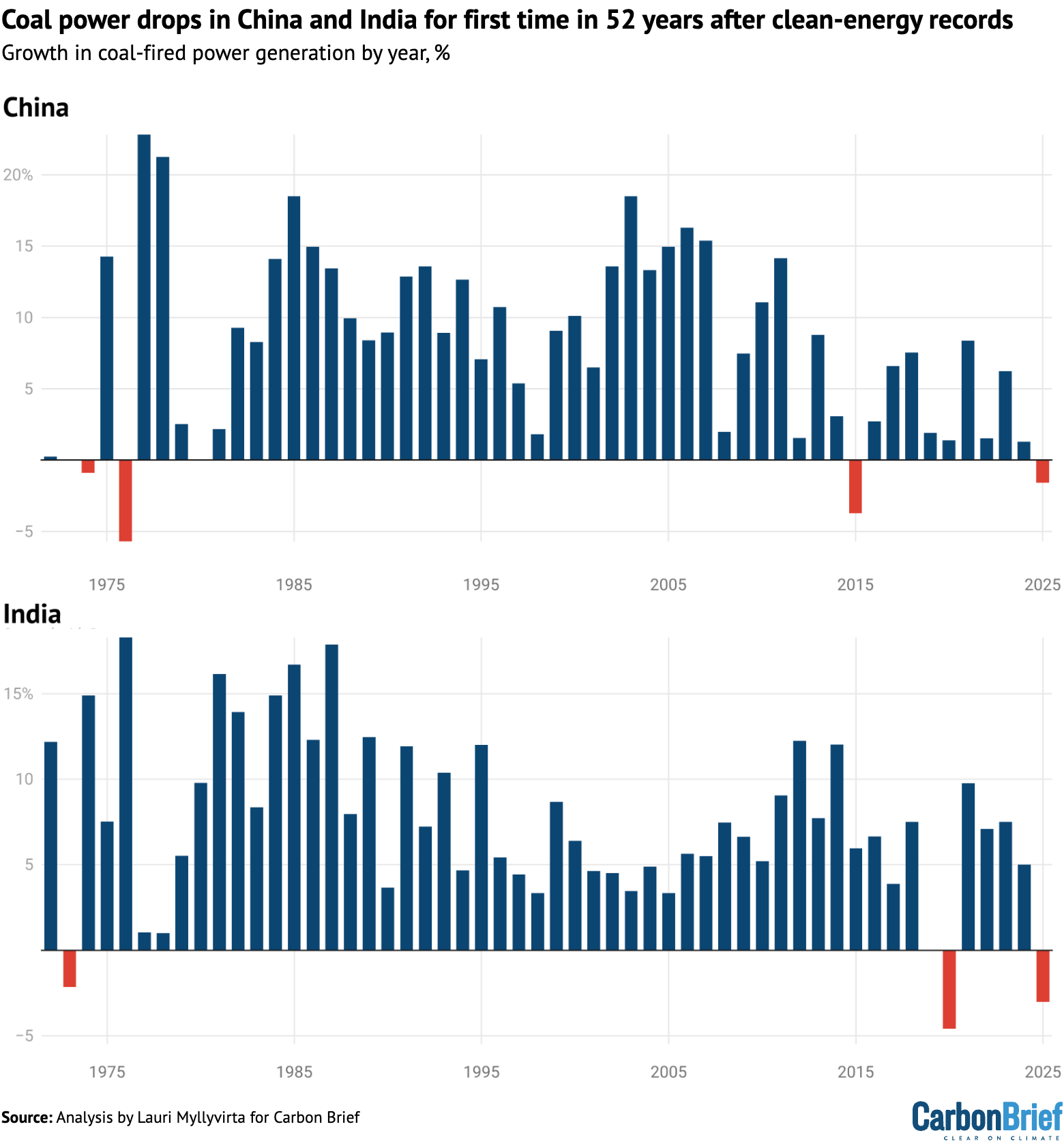
Growth in coal-fired power generation in China and India by year, %, 1972-2025. Source: Analysis by Lauri Myllyvirta for Carbon Brief.
China achieved this feat even as electricity demand growth remained rapid at 5% year-on-year. In India, the drop in coal was due to record clean-energy growth combined with slower demand growth, resulting from mild weather and a longer-term slowdown.
The simultaneous drop for coal power in both countries in 2025 is the first since 1973, when much of the world was rocked by the oil crisis. Both China and India saw weak power demand growth that year, combined with increases in power generation from other sources – hydro and nuclear in the case of India and oil in the case of China.
China’s recent clean-energy generation growth, if sustained, is already sufficient to secure a peak in coal power. Similarly, India’s clean-energy targets, if they are met, will enable a peak in coal before 2030, even if electricity demand growth accelerates again.
In 2025, China will likely have added more than 300 gigawatts (GW) of solar and 100GW of wind power, both clear new records for China and, therefore, for any country ever.
Power generation from solar and wind increased by 450TWh in the first 11 months of the year and nuclear power delivering another 35TWh. This put the growth of non-fossil power generation, excluding hydropower, squarely above the 460TWh increase in demand.
Growth in clean-power generation has kept ahead of demand growth and, as a result, power-sector coal use and CO2 emissions have been falling since early 2024.
Coal use outside the power sector is falling, too, mostly driven by falling output of steel, cement and other construction materials, the largest coal-consuming sectors after power.
In India’s case, the fall in coal-fired power in 2025 was a result of accelerated clean-energy growth, a longer-term slowdown in power demand growth and milder weather, which resulted in a reduction in power demand for air conditioning.
Faster clean-energy growth contributed 44% of the reduction in coal and gas, compared to the trend in 2019-24, while 36% was contributed by milder weather and 20% by slower underlying demand growth. This is the first time that clean-energy growth has played a significant role in driving down India’s coal-fired power generation
This analysis was written by Lauri Myllyvirta, lead analyst at CREA and senior fellow at Asia Society Policy Institute.
Read the full analysis here on Carbon Brief.